
Incoming waste cardboard is not free cushioning once someone must sort, prepare and handle it. Compare reuse with the fill you actually buy, using equivalent accepted parcels and the full workstation cost.
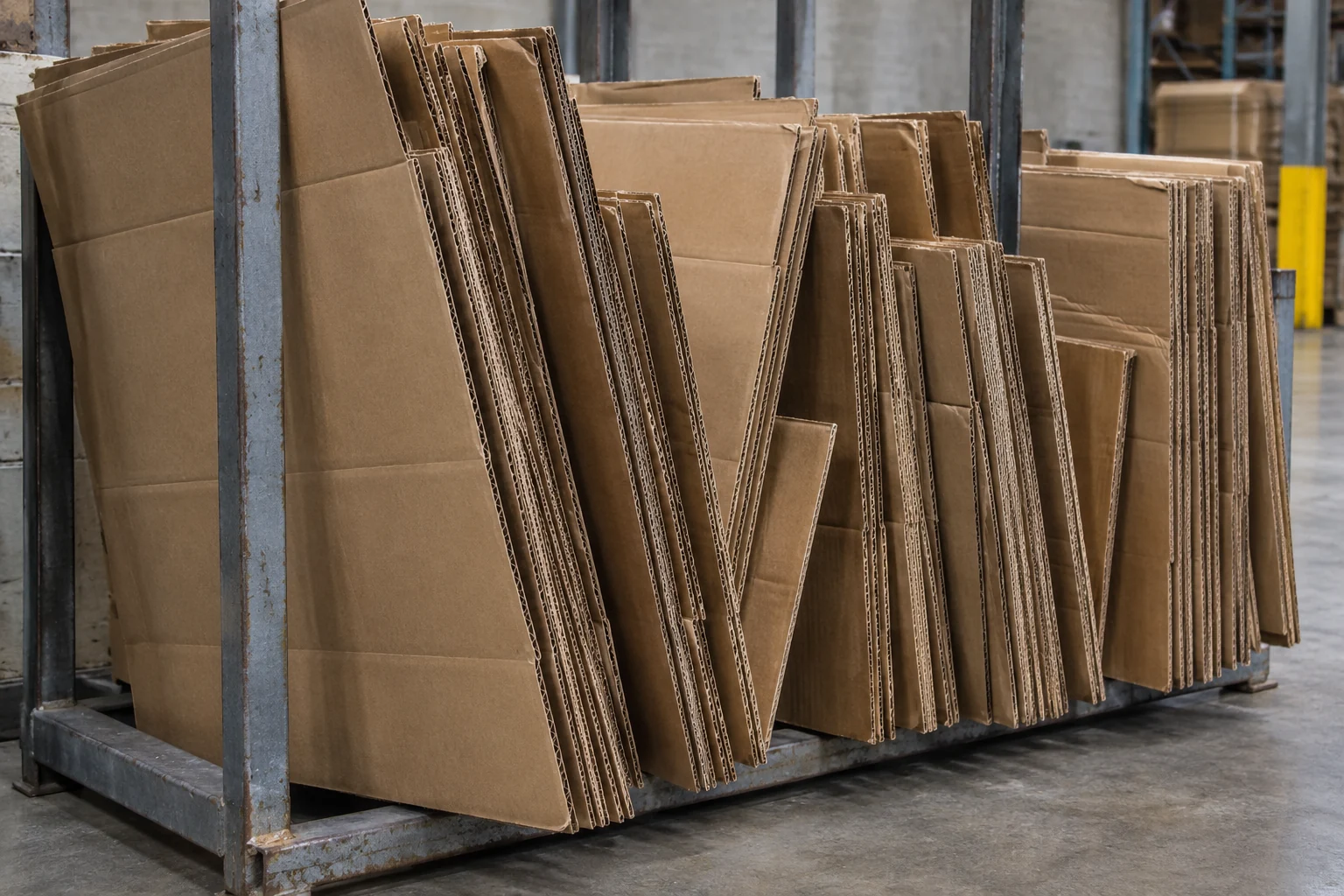
Reuse has an economic case when avoided spending exceeds the added preparation, packing and equipment costs. Count only board suitable for the selected process, and only purchased fill that an acceptable packout replaces. Keep recovered labor capacity separate from a reduction in cash expenditure.
Establish usable supply before equipment capacity
Log incoming board over a representative operating period. Separate suitable dry material from rejected or unavailable stock. Record preparation and movement time, including the distance between receiving, conversion, storage and packing.
HSM’s ProfiPack overview describes converting used cardboard to packing material. Its economic language is a manufacturer claim, not a measured saving for your workplace. The P425 manual defines a particular cardboard-padding application; it does not establish that every incoming carton is suitable feed.
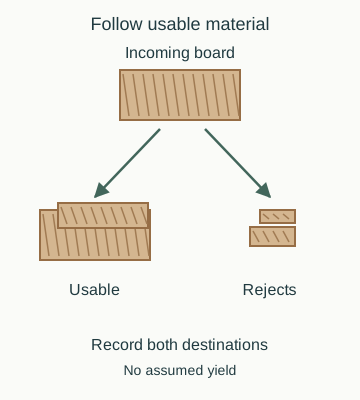
Use a material balance: incoming board = material sent for preparation + rejected or otherwise allocated board. Within preparation, record useful output and its offcuts separately. Use one unit, such as mass, throughout the balance. Do not equate a kilogram of converted board with a kilogram of purchased fill avoided.
Calculate the change over one period
Let A be purchased-fill spending avoided, D the actual reduction in waste-service charges, L added labor cost, O added operating and consumable cost, K allocated equipment ownership cost, and E other changed costs such as space or parcel size.
Net period benefit = A + D − L − O − K − E. This is a worksheet relationship. The variables require your observed inputs; it is not a forecast based on a typical machine price.
| Field | Record for the comparison | Evidence to retain |
|---|---|---|
| Accepted parcels and product mix | Same task in both methods | Packout and shipment records |
| Purchased material avoided | Consumption at equivalent protection | Purchase and usage records |
| Board preparation | Sorting, trimming and conversion work | Paid-time observations |
| Packing labor change | Additional placement or reduced handling | Whole-job observations |
| Operating additions | Energy, extraction consumables and service | Actual quote or measured consumption |
| Equipment basis | Installed cost and allocation period | Scope and accounting rule |
| Disposal change | Only charges that actually change | Waste-service contract |
| Other effects | Space, carton size, rejects and fallback fill | Observed change and valuation basis |
Do not add the same labor twice under preparation and operation. If electricity is estimated from a measured draw and running hours, state the measurement and tariff; a motor nameplate is not measured energy consumption.
Blank comparison record
Copy or print this record, or download the blank CSV record. Use one period and currency. Enter measured or documented values, including zero where appropriate; leave unknowns blank. Calculate the result rows yourself. The CSV has no automatic formulas.
| Record or calculation | Value | Evidence or allocation notes |
|---|---|---|
| Period: start and end | __________ | __________ |
| Currency | __________ | __________ |
| Product mix and acceptance rules | __________ | __________ |
| A: purchased-fill spending avoided | __________ | __________ |
| D: waste-service charge reduction | __________ | __________ |
| L: added labor cost | __________ | __________ |
| O: added operating and consumable cost | __________ | __________ |
| K: allocated equipment ownership cost | __________ | __________ |
| E: other changed cost | __________ | __________ |
| Net period benefit: A + D − L − O − K − E | __________ | __________ |
| Purchased-fill method: total comparable cost | __________ | __________ |
| Purchased-fill method: accepted parcels | __________ | __________ |
| Purchased-fill method: cost / accepted parcel | __________ | __________ |
| Reuse method: total comparable cost | __________ | __________ |
| Reuse method: accepted parcels | __________ | __________ |
| Reuse method: cost / accepted parcel | __________ | __________ |
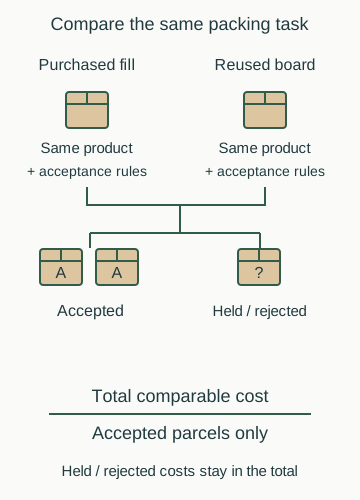
Divide each total comparable cost by that method’s accepted parcels. Leave a unit-cost result blank if its accepted count is zero, and retain the incurred cost. Keep the same cost boundary for both methods; the net-period calculation above records the changes within that boundary.
Normalize to an accepted packing task
Divide each method’s total comparable cost by accepted parcels over the same period. Rejected packs still incur cost in the numerator but do not become accepted output in the denominator. Explain changes in product mix before interpreting the difference.
A low material cost is unhelpful if it relies on an unproven packout. Use the cushioning guide to establish acceptance. If the output form causes extra handling, revisit the shredder-versus-perforator comparison.
Check the assumptions that can reverse the decision
Repeat the worksheet for a low-board-supply period and a demanding product mix. Include the purchased-fill fallback when reuse cannot supply the packing bench. Examine whether extra handling creates overtime or merely consumes spare capacity.
Waste collection is another common boundary error. A lower mass of discarded board may leave a fixed service fee unchanged. Conversely, removing one paid collection can create a real cash effect. Use the actual charging arrangement.
For simple cash payback, divide installed investment by positive monthly net cash savings, excluding non-cash allocations already represented in the investment. Label this simplified method; financing, tax and replacement timing require a broader analysis. No positive payback exists when recurring net cash savings are zero or negative.
Method and sources
The equations and blank records are original editorial tools. They assume no prices, tariffs, yields or savings. Manufacturer documents support the material-conversion role only. Find the related material and protection decisions in corrugated reuse. Updated October 2026.