A corrugated packaging machine can reduce unnecessary carton space, but on-demand box sizing can also cut away clearance that cushioning requires. Set the box around the actual arranged order and its validated protection envelope, then measure board, fill and operating cost per accepted pack.
On-demand box sizing should target the protected order, including required cushioning and clearances. Product dimensions alone cannot establish the smallest acceptable carton. Compare the assembled box’s internal dimensions with the actual pack arrangement, check the selected converter’s board limits, and validate the finished construction. A reduction in geometric void is a dimensional result; actual filler consumption and total cost need separate records from equivalent accepted packouts.
On-demand box sizing. Size around the protected order.
- Measure
- Protect
- Convert
- Compare

Packing station arrangement showing a rigid item nested in kraft paper cushioning within a sized corrugated carton.
Start with the following dimensional and converting inputs before changing carton sizes:
| Input or item | Typical value or source | Why it matters |
|---|---|---|
| Assembled carton interior | Measured internal length, width and height in mm | Defines the usable geometric envelope; retain external shipping dimensions separately. |
| Arranged order | Actual orientation, grouped items and protrusions; Packsize FAQ dimension-input discussion | A database record or scanner cuboid may not describe the final packing arrangement. |
| Protection envelope | Validated face clearances and protective components for the product and distribution route | Identifies space that downsizing must retain. |
| Board and converter compatibility | Exact OEM table; example: KOLBUS BX 2600 lists 1.3–16 mm caliper | A configuration-specific intake window does not establish finished-pack strength. |
| Actual consumption | Allocated board, trim/rejects and fill mass per accepted pack; same operating period and product mix | Connects dimensional change to material spending. |
Choose the workflow around the dimension source
Box-first production depends on reliable order data; box-last production depends on the measured group remaining representative through packing. Packsize’s Continuously Variable Packaging: Right-Sized Automation for Smarter Fulfillment, December 17, 2025, describes order scanning, fanfold conversion and closure/labeling. Its FAQ describes dimension inputs from order records, barcode-linked data, dimensioning equipment or an operator.
The comparison below draws on Packsize’s Maximizing Fulfillment Efficiency (October 8, 2025), Packsize’s FAQ, and KOLBUS’s BX Motion Pro documentation for sheet-fed conversion:
| Configuration | Useful comparison boundary | Protection implication | Dominant Failure Mode & Prevention |
|---|---|---|---|
| Stock cartons plus fill | Existing accepted packout and actual material use | Establishes the baseline protection recipe | Product travel or inconsistent placement inside excess space. Define and validate the pack recipe; record actual fill and acceptance. |
| Box-first blanks from order data | Accurate item records, orientation and controlled substitutions | Include protective additions before determining blank size | Wrong dimensions create an undersized carton. Check master data against the protected envelope and divert mismatches before cutting. |
| Box-last scan and fit-to-size production | Consolidated picked group, scan, transfer and packing | Include protection and keep the measured arrangement representative | Protrusions or rearrangement invalidate the fit; scan/transfer queues interrupt flow. Verify the complete group, preserve allowances and provide an exception route. |
| Sheet-fed on-demand conversion | Blank production with the documented tooling, board and format | Forming, filling and closure remain separate tasks unless integrated | Incompatible board, faulty scores or joints cause converting or box failure. Check the exact material window and validate the formed construction. |
A converter’s linear speed cannot be treated as parcels shipped. Follow an order through forming, protective placement, closure and exception handling before using a production claim to size the line.
Calculate volume around the protected packout
Internal carton volume exposes excess space only when the occupied product and protected envelope have clear definitions. Measure the assembled interior and the product arrangement in its intended orientation. Record units, measurement resolution, board condition, closure and protective components. An order scanner’s bounding cuboid does not measure every inter-item gap or the solid volume of irregular products.
For an explicitly rectangular arrangement, use these geometry definitions:
V_box = L_i × W_i × H_i
V_free = V_box − V_product
V_excess = V_box − V_env
Here V_product is occupied product/sales-pack volume under the declared measurement convention. V_env is the rectangular envelope that includes required protection. V_free therefore includes protective space; V_excess describes space outside that protected envelope. All volumes must use compatible units, and the arrangement must fit on each axis. A negative residual signals invalid inputs or an inadmissible pack.
Worked geometry example: for a rigid rectangular product measuring 200 × 150 × 100 mm with a validated design requiring 20 mm on each opposing face, the protected envelope is 240 × 190 × 140 mm. Comparing an existing stock carton measuring 300 × 250 × 200 mm internally against a sized carton whose interior equals that 240 × 190 × 140 mm protected envelope gives:
ΔV_box = [(300 × 250 × 200) − (240 × 190 × 140)] mm³ ÷ 1,000,000 mm³/L = 8.616 L less internal carton volume.
Within this design, the product occupies 3.000 L, the old carton 15.000 L, and the new carton 6.384 L, reserving 6.384 − 3.000 = 3.384 L outside the product for its validated cushioning layer.
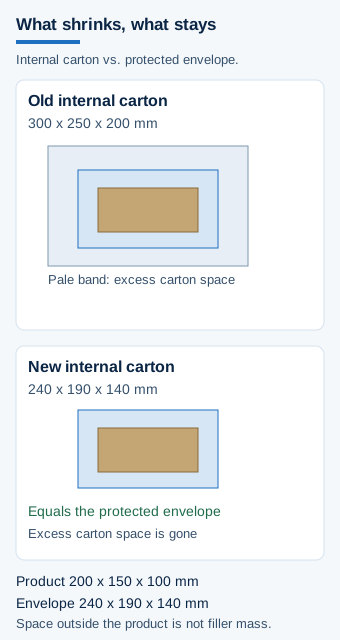
Comparison of a 300 × 250 × 200 mm stock carton against a 240 × 190 × 140 mm right-sized carton preserving the 20 mm per-face cushioning envelope around a 200 × 150 × 100 mm product.
For irregular or mixed orders, label any bounding-cuboid approximation. Keep cavities within the arrangement distinct from space outside it. To measure fill savings, weigh or tally the material actually used in both accepted packouts: Δm_fill = m_fill,old − m_fill,new, using the same mass unit.
Worked scale comparison: when the stock accepted packout uses 80 g of fill and the right-sized accepted packout uses 35 g, Δm_fill = 80 g − 35 g = 45 g less fill per accepted pack.
Stop downsizing when a face clearance fails
The protection threshold is the validated requirement for each face. If any available clearance falls below the corresponding required clearance, stop downsizing or redesign and validate the protection before removing fill. An unknown required clearance prevents approval of a smaller pack.
For a centered rectangular product, define c_x = (L_i − L_p) / 2, with equivalent expressions for width and height, in the same length unit. The divisor represents the opposing face clearances. If min(c_x − r_x, c_y − r_y, c_z − r_z) < 0, the proposed geometry fails at least one required allowance. For an asymmetric arrangement, check every face separately. Equality leaves no tolerance reserve; assess measurement and converting variation before approval.
In the 200 × 150 × 100 mm example above, reducing internal height below 140 mm violates the vertical allowance because 100 mm product height + 20 mm lower allowance + 20 mm upper allowance = 140 mm.
Packsize’s FAQ allows protective material within fitted boxes; the public scope of ASTM D5639/D5639M-25, especially §1.3.5, requires construction/design validation through samples, testing and prototype packing/shipping. Use the cushioning packout guide to define the acceptance evidence for the product and its distribution conditions.
Separate board intake from finished-box performance
A board that a converter can process still needs a suitable box construction. KOLBUS’s BX Motion Pro page, Technical Data → BX 2600, lists single-, double- and triple-flute blank material with 1.3–16 mm material thickness, noting that net performance depends on material and format.
For that published BX 2600 configuration, caliper outside 1.3–16 mm lies outside the listed window: a measured blank caliper of 17 mm exceeds the listed 16 mm maximum, whereas a 10 mm blank sits inside the intake window and proceeds to finished-box validation. Even within the intake window, verify stock condition, tooling, score quality, joint integrity and the accepted finished pack.

Corrugated blank score line and manufacturer’s joint alongside a formed carton corner.
The public ASTM D5639/D5639M-25 scope and significance text, §§1.1–1.3.5 and 4.1–4.2, relates material and construction attributes to intended use and distribution hazards, noting that material specifications alone do not guarantee a well-made box without pack validation.
Packsize’s The Importance of Using High-Quality Fanfold Corrugated links fanfold and board selection to variable box production and waste. Record web width and the developed blank layout. Flaps, joints, cutouts and trim mean that a closed carton cuboid’s surface area cannot substitute for purchased board consumption.
Compare actual consumables and complete operating cost
The economic result depends on material and paid work per accepted parcel. Keep the same product mix, protection acceptance rules, operating period and cost boundary for both methods:
C_accepted = (C_board + C_fill + C_closure + C_pack_labor + C_changeover + C_energy/service + C_equipment + C_rework/fallback) / N_accepted
Express each cost in the same currency per comparison period; the result is currency per accepted parcel. Rejects remain in the cost numerator and are excluded from accepted output. If accepted output is zero, unit cost is undefined; retain the incurred period cost.
Worked period calculation: for a comparison period with board cost $400, fill $80, closure $20, packing labor $150, changeover $30, energy and service $40, equipment $60, and rework/fallback $20 (total $800) across 100 accepted parcels (with two rejected parcels captured in the rework total), C_accepted = $800 / 100 = $8.00 per accepted parcel.
| Record | What to include | Error it prevents |
|---|---|---|
| Board | Purchased board allocated to consumed stock, trim and failed blanks; inventory movement | Treating a smaller internal cuboid as measured board savings |
| Fill | Actual consumed material, including rejects and reclaimed-fill preparation | Converting a geometric volume reduction directly into spending avoided |
| Changeover and replenishment | Width/grade changes, stock loading, tooling, calibration, data/job changes and recovery time | Assuming automatic repositioning removes all manual work or pauses |
| Energy and service | Metered energy over the complete interval, included auxiliaries and documented service costs | Treating a motor label as unit energy consumption |
| Packing and exceptions | Protective placement, forming, closure, rework and fallback cartons | Omitting downstream work from the conversion decision |
Allocate changeover from logged resource time and the corresponding paid rate, plus changeover waste. Count each cost once: time already in paid packing labor should not appear again as an overlapping downtime charge. Distinguish available labor capacity from an actual payroll reduction.
For board mass, reconcile consumed stock to board in accepted boxes plus trim/reject mass, accounting for inventory movement. For fill, record the actual packing method and consumption. Retain the baseline packout and its acceptance evidence so that a tidier or smaller box does not silently change the comparison task.
Use the reuse economics guide when reclaimed cardboard contributes to the fill supply, and the void-fill machinery guide when collection, dosing or placement becomes the downstream constraint.
Technical basis and scope
This reference draws on Packsize fulfillment workflow documentation (Continuously Variable Packaging, Maximizing Fulfillment Efficiency, FAQ, and fanfold corrugated specifications), KOLBUS BX Motion Pro (BX 2600) technical data, and ASTM D5639/D5639M-25 scope and significance criteria for corrugated shipping containers. Explore corrugated reuse for incoming-board and downstream packing decisions around the sized carton.