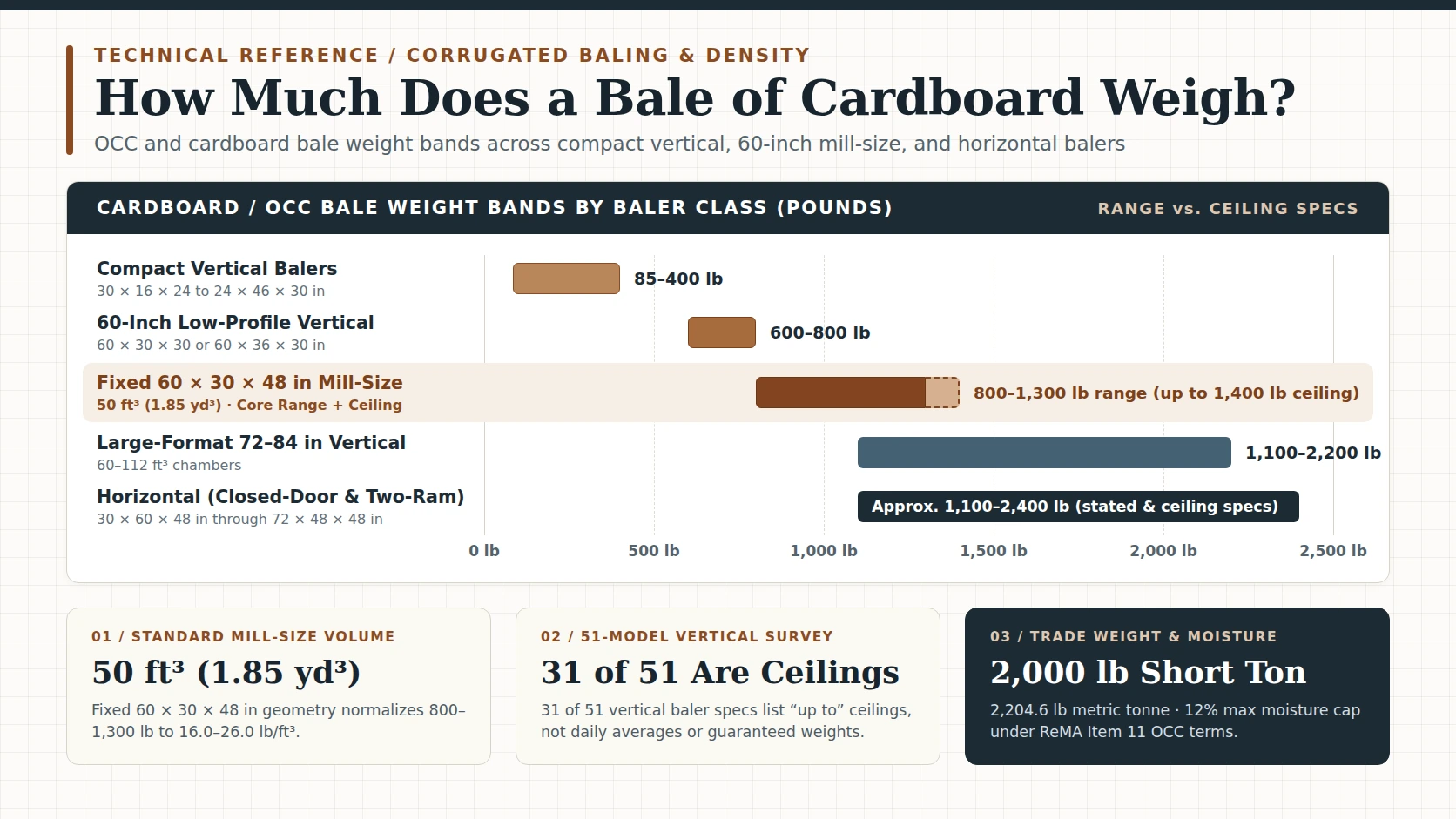
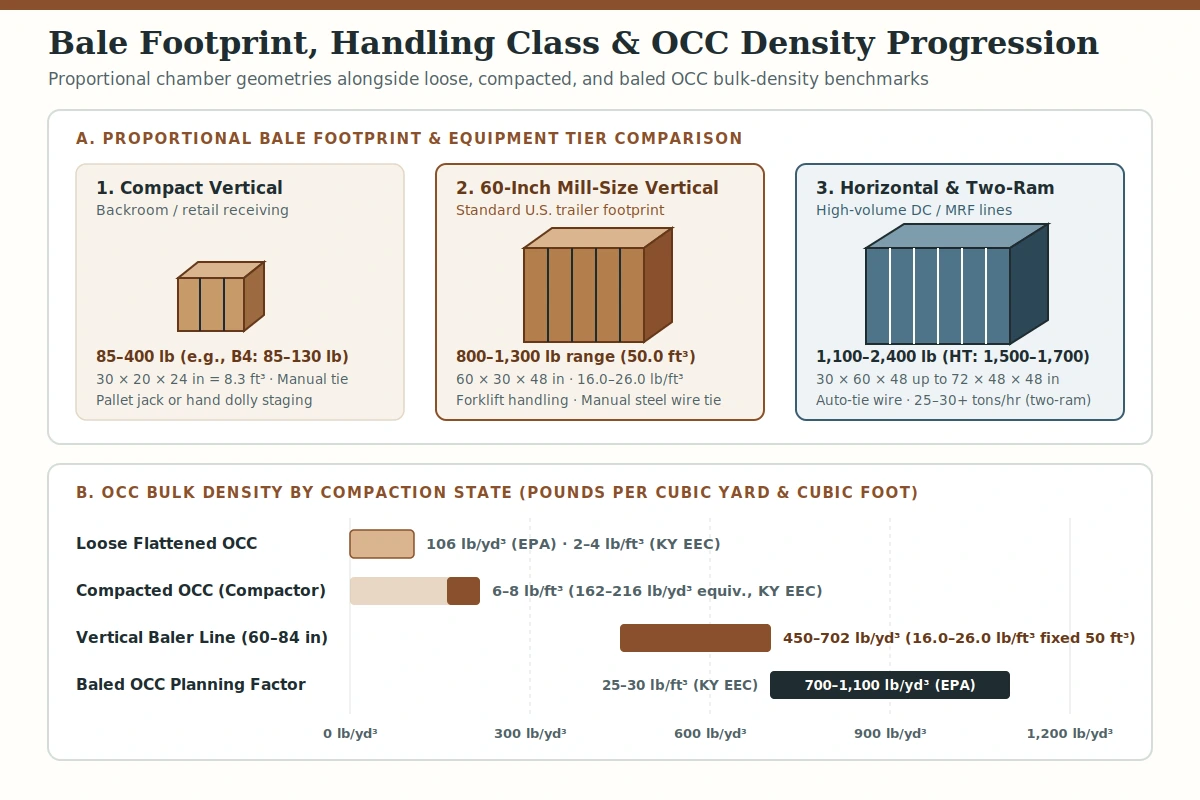
A standard fixed 60 × 30 × 48-inch mill-size bale of cardboard weighs 800 to 1,300 pounds across current vertical-baler models specifying weight ranges, normalizing to 16.0–26.0 lb/ft³ inside a 50 ft³ chamber. Across equipment classes, cardboard bale weight runs from 85–400 pounds on compact vertical units to approximately 1,100–2,400 pounds on horizontal machines.
Accurate bale-weight planning matters before choosing a cardboard baler machine or committing dock space within a broader corrugated reuse workflow. Facilities that mistake a manufacturer’s upper-limit brochure ceiling for a routine daily average overestimate trailer payloads and risk buyer light-load fees when shipments cross the scale short of contract minimums.
What Determines Finished Cardboard Bale Weight Across Baler Classes?
Finished cardboard bale weight is governed by five interacting variables: chamber volume and finished height, hydraulic platen force and ram pressure, whether the manufacturer specifies a weight range or an upper-limit ceiling, fiber grade composition, and moisture content. No single universal average applies across all machines because chamber geometry and specification wording vary widely.
Across 51 current U.S.-market vertical-baler models from eight manufacturers—Komar Industries, Bramidan, Harmony Enterprises, BACE, MAX-PAK, Marathon Equipment, PTR Baler & Compactor, and Cram-A-Lot—collected from OEM websites and manufacturer PDFs by independent publisher Indianapolis Compactor Repair Research, 19 models list explicit weight ranges, 31 models list upper-limit ceilings phrased as up to a maximum weight, and 1 model lists a single stated value.
Because a ceiling records an upper limit rather than a typical produced bale, those 31 ceiling-rated models cannot be averaged as measured outputs. Material grade also separates clean Old Corrugated Containers (OCC) from general cardboard: ReMA Item 11 of ReMA’s ISRI Scrap Specifications (paper stock section, effective July 14, 2022, aligning with U.S. HTS heading 4707.10.00.00 for unbleached kraft or corrugated paper waste and scrap, code 4707100000) defines OCC as corrugated containers with test liner or kraft liner, capping prohibitive materials at 1% and combined outthrows plus prohibitives at 5%. Water also adds unpayable mass, which is why ReMA paper-stock terms require paper to be packed dry with a 12% maximum moisture limit unless buyer and seller agree otherwise.
How Much Heavier Is a Mill-Size or Horizontal Bale Than a Compact Bale?
A fixed 60 × 30 × 48-inch mill-size vertical bale weighs 800–1,300 pounds across manufacturer weight ranges (or up to 1,400 pounds in same-size ceiling ratings), compared with compact vertical bales starting at 85–130 pounds on entry-level units and spanning 85–400 pounds across the compact class. Large-format 72–84 inch vertical bales reach 1,100–2,200 pounds, and horizontal bales span approximately 1,100–2,400 pounds.
Across vertical balers that specify weight ranges, output begins at 85–130 pounds on Bramidan’s B4 (30 × 20 × 24 inches, 8.3 ft³, 8,800 pounds working force), steps up to 450–550 pounds on Bramidan’s mid-size B20 (48 × 30 × 30 inches, 25.0 ft³, 44,100 pounds force), and reaches 800–1,200 pounds on Bramidan’s 60-inch B6030 (60 × 30 × 48 inches, 50.0 ft³, 66,200 pounds force). At the upper end of vertical machines, Komar’s 84-inch VB8448 specifies an OCC weight range of 1,850–2,200 pounds.
Four fixed 60 × 30 × 48-inch vertical-baler models specify standard weight ranges rather than ceilings: Bramidan B6030 and X6030 LP at 800–1,200 pounds, Komar VB6030-2300HD at 850–1,000 pounds, and Komar VB6030-3400HD at 1,000–1,300 pounds. Among same-size 50 ft³ ceiling models, Cram-A-Lot’s DX-60-8 lists up to 1,400 pounds (28.0 lb/ft³ normalized ceiling at 100,500 pounds of force). Horizontal equipment separates into a distinct tier because open-end units vary bale length and two-ram designs compress fiber against a heavy steel sidewall: Komar’s HT175 through HT500 two-ram models list stated OCC bales of 1,500, 1,600, and 1,700 pounds at approximately 30 × 60 × 48 inches, while Cram-A-Lot closed-end horizontal units list OCC ceilings from up to 1,100 pounds (HH-60, 60 × 30 × 40 inches) and 1,400 pounds (HX-60, 60 × 30 × 40 inches) up to 2,200 pounds (HX-72, 72 × 42 × 28 inches) and 2,400 pounds (HX-72-W, 72 × 48 × 48 inches).
| Baler Class | Representative Bale Dimensions | Typical OCC Bale Weight | Models Surveyed |
|---|---|---|---|
| Compact vertical | 30 × 16 × 24 in through 24 × 46 × up to 30 in | 85–400 lb | 11 vertical models |
| Mid-size vertical | 48 × 30 × 30 in through 42 × 30 × 48 in | 400–1,000 lb | 6 vertical models |
| 60-inch low-profile vertical | 60 × 30 × 30 in or 60 × 36 × 30 in | 600–800 lb | 4 vertical models |
| Fixed 60 × 30 × 48 in mill-size vertical | Exactly 50.0 ft³ (about 1.85 yd³) | 800–1,300 lb range; up to 1,400 lb ceiling | 15 vertical models |
| Variable-height 60-inch vertical | 30 × 60 × up to 48 or 51 in | Up to 1,000–1,500 lb | 4 vertical models |
| Large-format 72–84 in vertical | 72–84 in wide (fixed or adjustable height) | 1,100–2,200 lb | 11 vertical models |
| Horizontal (closed-end and two-ram) | 30 × 60 × 48 in through 72 × 48 × 48 in | Approximately 1,100–2,400 lb | 17 horizontal models |
How Do Baler Chamber Geometry and Platen Force Change Bale Weight?
Inside a fixed 50 ft³ (60 × 30 × 48-inch) chamber, higher hydraulic platen force raises ram pressure in psi and packs more corrugated mass into the exact same bale dimensions. Across different chamber sizes, however, platen surface area spreads hydraulic force over more square inches, so a larger chamber makes a heavier bale without automatically producing higher density.
Escalating Platen Force Inside a Fixed 50 ft³ Chamber
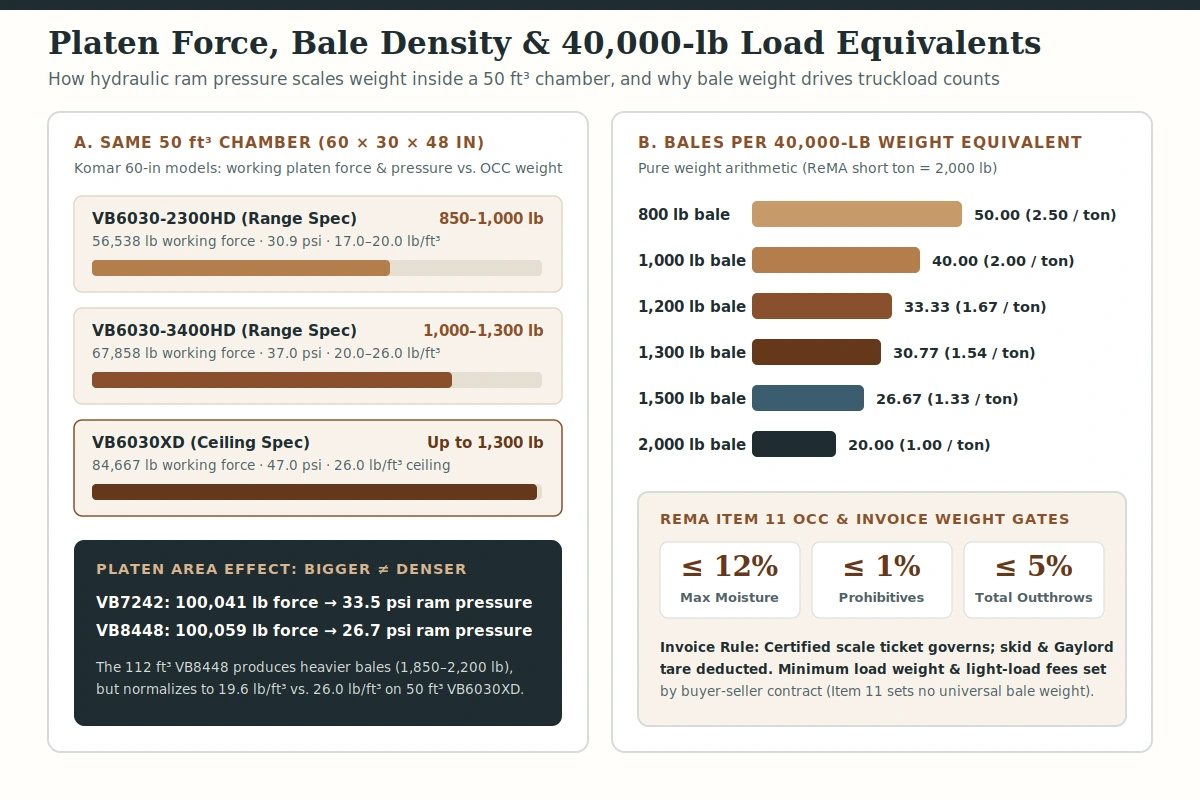
Comparing four Komar 60 × 30 × 48-inch models isolates the effect of hydraulic ram pressure when chamber geometry stays fixed at 50.0 ft³. Moving from the VB6030-2300HD at 56,538 pounds of working platen force (30.9 psi) to the VB6030-3400HD at 67,858 pounds (37.0 psi) shifts the rated OCC weight range upward from 850–1,000 pounds (17.0–20.0 lb/ft³) to 1,000–1,300 pounds (20.0–26.0 lb/ft³). Stepping up again to the VB6030XD at 84,667 pounds of working force (47.0 psi) carries a ceiling of up to 1,300 pounds (26.0 lb/ft³ normalized ceiling).
Why Larger Chambers Do Not Automatically Produce Denser Bales
Because pressure equals total hydraulic force divided by platen face area, a wider and deeper chamber can dilute ram pressure even when cylinder force rises. Komar’s VB7242 and VB8448 list nearly identical working forces of 100,041 pounds and 100,059 pounds, yet their normal ram pressures drop from 33.5 psi on the VB7242 to 26.7 psi on the wider VB8448. Consequently, while the 84-inch VB8448 forms a heavier finished bale (1,850–2,200 pounds), its 2,200-pound upper endpoint normalizes to roughly 19.6 lb/ft³, well below the 26.0 lb/ft³ ceiling density of the smaller 60-inch VB6030XD.
Planners should also separate bale weight from equipment weight when checking floor loading and rigging: Marathon’s V-6030 HD manufacturer brochure specifies OCC bales up to 1,100 pounds while the press itself carries a machine unit weight of 4,800 pounds.
| Komar Vertical Model | Bale Dimensions | Spec Type and Weight | Working Platen Force | Normal Ram Pressure | Normalized Density |
|---|---|---|---|---|---|
| VB6030CB | 60 × 30 × 48 in (50.0 ft³) | Ceiling: up to 1,000 lb | 56,548 lb | 32.0 psi | 20.0 lb/ft³ ceiling |
| VB6030-2300HD | 60 × 30 × 48 in (50.0 ft³) | Range: 850–1,000 lb | 56,538 lb | 30.9 psi | 17.0–20.0 lb/ft³ |
| VB6030-3400HD | 60 × 30 × 48 in (50.0 ft³) | Range: 1,000–1,300 lb | 67,858 lb | 37.0 psi | 20.0–26.0 lb/ft³ |
| VB6030XD | 60 × 30 × 48 in (50.0 ft³) | Ceiling: up to 1,300 lb | 84,667 lb | 47.0 psi | 26.0 lb/ft³ ceiling |
| VB8448 | 84 × 48 × 48 in (112.0 ft³) | Range: 1,850–2,200 lb | 100,059 lb | 26.7 psi | 19.6 lb/ft³ top range |
How Do Recyclers Calculate What a Bale of Cardboard Is Worth?
Recyclers calculate a cardboard bale’s gross commodity value by dividing certified net bale weight in pounds by 2,000 (one U.S. short ton) and multiplying by the negotiated OCC price per ton, then adjusting for fiber grade, contamination, moisture, skid or Gaylord tare deductions, freight, and contract load minimums.
Under ReMA paper-stock trade terms, a U.S. short ton equals 2,000 pounds and a metric tonne equals 2,204.6 pounds. Neither ReMA Item 11 nor its paper-stock terms prescribe a universal minimum bale weight or trailer payload; instead, buyer and seller must establish minimum load weights and any light-load fees before shipment. When a warehouse plans trailer staging around a 1,300-pound brochure ceiling but actually produces 800-pound bales, reaching a 40,000-pound weight equivalent jumps from 30.77 bales to 50.00 bales—leaving trailers short on payload if dock space or stacking height runs out first.
Scale governance and tare rules also affect invoice totals directly. Under ReMA terms, the buyer’s certified-scale weight governs any discrepancy, while the seller’s certified-scale ticket governs if the buyer lacks a certified scale. The weight of skids, Gaylord boxes, and similar shipping materials is deducted from gross invoice weight, while cardboard sides and headers require prior agreement and may not be excessive. Paper is packed dry under ReMA’s 12% maximum moisture limit, where excess moisture can support a weight adjustment or rejection. Separately, ReMA Item 11 caps prohibitive materials at 1% and combined outthrows plus prohibitives at 5%.
| Measured Bale Weight | Bales per 2,000-lb Short Ton | Bales per 2,204.6-lb Metric Tonne | Bales per 40,000-lb Weight Equivalent |
|---|---|---|---|
| 800 lb | 2.50 | 2.76 | 50.00 |
| 1,000 lb | 2.00 | 2.20 | 40.00 |
| 1,100 lb | 1.82 | 2.00 | 36.36 |
| 1,200 lb | 1.67 | 1.84 | 33.33 |
| 1,300 lb | 1.54 | 1.70 | 30.77 |
| 1,400 lb | 1.43 | 1.57 | 28.57 |
| 1,500 lb | 1.33 | 1.47 | 26.67 |
| 1,700 lb | 1.18 | 1.30 | 23.53 |
| 2,000 lb | 1.00 | 1.10 | 20.00 |
When Does Box Waste Volume Make a Cardboard Baler Worth Installing?
A cardboard baler becomes financially viable once loose corrugated volume makes uncompacted hauling inefficient—commonly when a facility requires more than one weekly loose-cardboard pickup—and when clean, dry OCC can be kept source-separated rather than losing commodity value in general waste streams.
Volume reduction drives the hauling shift. In the U.S. EPA Volume-to-Weight Conversion Factors memorandum issued in April 2016, flattened Old Corrugated Containers convert at 106 pounds per cubic yard (sourced to Keep America Beautiful’s December 2013 report), uncompacted OCC and chipboard convert at 74.54 pounds per cubic yard, and baled OCC converts at 700–1,100 pounds per cubic yard (sourced to WasteCare Corporation’s April 2015 reference). Because the EPA memorandum explicitly notes that primary data collection was not performed, planners should treat 700–1,100 lb/yd³ as a planning range rather than a measured federal average—especially since Komar’s fixed-height 60- through 84-inch vertical baler line normalizes to 450–702 lb/yd³ and a legacy EPA-hosted chart lists 900 pounds (486 lb/yd³) for a 30 × 60 × 48-inch bale.
National recovery volumes confirm how heavily commercial logistics rely on clean OCC streams. According to U.S. EPA containers and packaging data for 2018 municipal solid waste (MSW), corrugated boxes were the largest single MSW product category at 33.3 million tons generated (11.4 percent of total generation), with approximately 32.1 million tons recycled out of 33.9 million tons of total paper and paperboard recycling—a 96.5 percent recycling rate—alongside 230,000 tons combusted and 940,000 tons landfilled.
| Material State or Reference Basis | Typical Density / Conversion | Source Method and Scope |
|---|---|---|
| Uncompacted OCC and chipboard | 74.54 lb/yd³ | U.S. EPA April 2016 memorandum (Keep America Beautiful, Dec 2013) |
| Loose flattened OCC boxes | 106 lb/yd³ | U.S. EPA April 2016 memorandum (Keep America Beautiful, Dec 2013) |
| Loose OCC | 2–4 lb/ft³ | Kentucky EEC Community Recycling Guide |
| Compacted OCC (non-baled) | 6–8 lb/ft³ | Kentucky EEC Community Recycling Guide |
| Legacy 30 × 60 × 48 in OCC bale | 900 lb (486 lb/yd³) | Legacy EPA-hosted conversion chart |
| Fixed-height 60–84 in vertical baler line | 450–702 lb/yd³ | Normalized upper endpoints across Komar 60–84 in specs |
| Baled OCC planning factor | 700–1,100 lb/yd³ | U.S. EPA April 2016 memorandum (WasteCare Corporation, Apr 2015) |
| Typical baled OCC | 25–30 lb/ft³ | Kentucky EEC Community Recycling Guide |
Operating Costs, Storage Space, and Workplace Safety Gates
Commercial recycling processor FV Recycling emphasizes evaluating labor allocation, bale wire usage, repair risk, preventative maintenance, and internal recycling oversight before purchasing equipment. The Kentucky Energy and Environment Cabinet Community Recycling Guide adds two operational constraints: buyers generally expect an OCC bale to consist of 70% or more old corrugated containers, and facilities must reserve sufficient storage room to stockpile stacks of baled material for several months during down commodity markets.
Heavy bales and hydraulic rams also introduce strict safety obligations. OSHA’s cardboard-baling hazard guidance documents a forklift operator fatally crushed by 1,600 pounds of baled cardboard and another worker crushed by a baling machine, warning that unintended activation can have catastrophic results. Similarly, a NIOSH baler safety bulletin documented 34 worker deaths between 1992 and 2000 from baler and compactor rams. NIOSH recommends de-energizing, locking out, and tagging out machines under OSHA rules whenever unjamming, maintaining, or repairing equipment, fitting guards and safety interlocks that immediately stop the ram upon access, and enforcing federal age-18 labor rules (under which workers aged 16 and 17 may only load de-energized scrap paper balers locked in the off position with a posted compliance notice).
When Should a Warehouse Use a Cardboard Baler Instead of a Compactor?
Use a cardboard baler when incoming corrugated volume is clean, dry, and steady enough to produce wire-tied mill-ready OCC bales that maximize trailer density (25–30 lb/ft³) and qualify for commodity recovery. Use a compactor when cardboard volumes are low, operator labor is scarce, contamination blocks consistent bales, or a nearby processor accepts compacted loose OCC.
The Kentucky Community Recycling Guide summarizes the operational hierarchy directly: bale OCC if possible, densify in a compactor if a nearby market accepts compacted material (6–8 lb/ft³ versus 2–4 lb/ft³ loose), and flatten boxes to ship loose only when no other option exists. Because recyclers generally offer better pricing for compacted or baled fiber and densification lowers hauling costs, choosing equipment comes down to matching daily tonnage and tying labor to the right press architecture.
Vertical balers represent low-density presses suited to small-volume operations producing a few manually wire-tied bales per day. Single-ram open-end horizontal balers deliver medium density with variable bale lengths tailored to buyer requirements, whereas closed-door horizontal units with a hinged bale door fix bale length and run at somewhat slower production rates. High-volume facilities rely on two-ram balers, whose perpendicular ejection ram compresses fiber against a heavy steel sidewall for high-density output at 25 to 30 or more tons per hour. By contrast, FV Recycling notes that sending loose OCC through a standard compactor provides no resale value.
| Equipment Pathway | Typical Density or Output Role | Tying and Labor Profile | Best-Fit Facility Condition |
|---|---|---|---|
| Vertical hydraulic baler | Low-density; 85–130 lb (B4) to 1,850–2,200 lb (VB8448) | Manual wire or strap tying; a few bales per day | Retail backrooms and warehouses past one weekly loose pickup |
| Single-ram horizontal baler | Medium density; closed-door fixed length or open-end variable length | Manual or automatic wire strapping; slower on hinged-door models | Mid-to-high-volume docks matching buyer-specific bale lengths |
| Two-ram horizontal baler | High density; 1,500–1,700 lb on 30 × 60 × 48 in HT models; 25–30+ tons/hr | Usually fitted with automatic wire tying and perpendicular ejection ram | Facilities with high daily production volumes |
| Stationary waste compactor | 6–8 lb/ft³ compacted OCC; lower density than tied bales | No manual bale tying; suited to limited labor | Low volume, scarce labor, high contamination, or nearby compacted-OCC buyer |
Industry Standards and Equipment Specifications Referenced
In addition to the federal and state agency documents listed under Sources below, this guide draws on three industry references:
- ReMA’s ISRI Scrap Specifications (Paper Stock Section): Item 11 (Old Corrugated Containers, HTS code 4707100000, effective July 14, 2022) and paper-stock trade terms covering the 2,000-pound short ton, 2,204.6-pound metric tonne, 12% moisture limit, 1% prohibitive and 5% combined outthrow limits, tare deductions, and certified-scale discrepancy rules.
- Manufacturer Vertical and Horizontal Baler Specifications: Current U.S. product pages and brochures from Komar Industries, Bramidan, Harmony Enterprises, BACE, MAX-PAK, Marathon Equipment, PTR Baler & Compactor, and Cram-A-Lot, as compiled across 51 vertical models and 17 horizontal models by independent publisher Indianapolis Compactor Repair Research.
- Commercial Recycling Processor Guidance (FV Recycling): Operational benchmarks on weekly loose-cardboard pickup thresholds, recurring baler upkeep expenses, and baler-versus-compactor trade-offs.
Warehouses that also purchase void-fill packing materials should weigh whether part of their clean incoming carton stream delivers more value on-site than inside a bale. Compare vertical baling presses directly against on-site perforators in our cardboard recycling machine baler vs void-fill converter guide, model avoided fill spending against labor and disposal changes in our cardboard shredder cost and reuse economics guide, or browse equipment categories in our cardboard shredders hub before finalizing dock layout.