
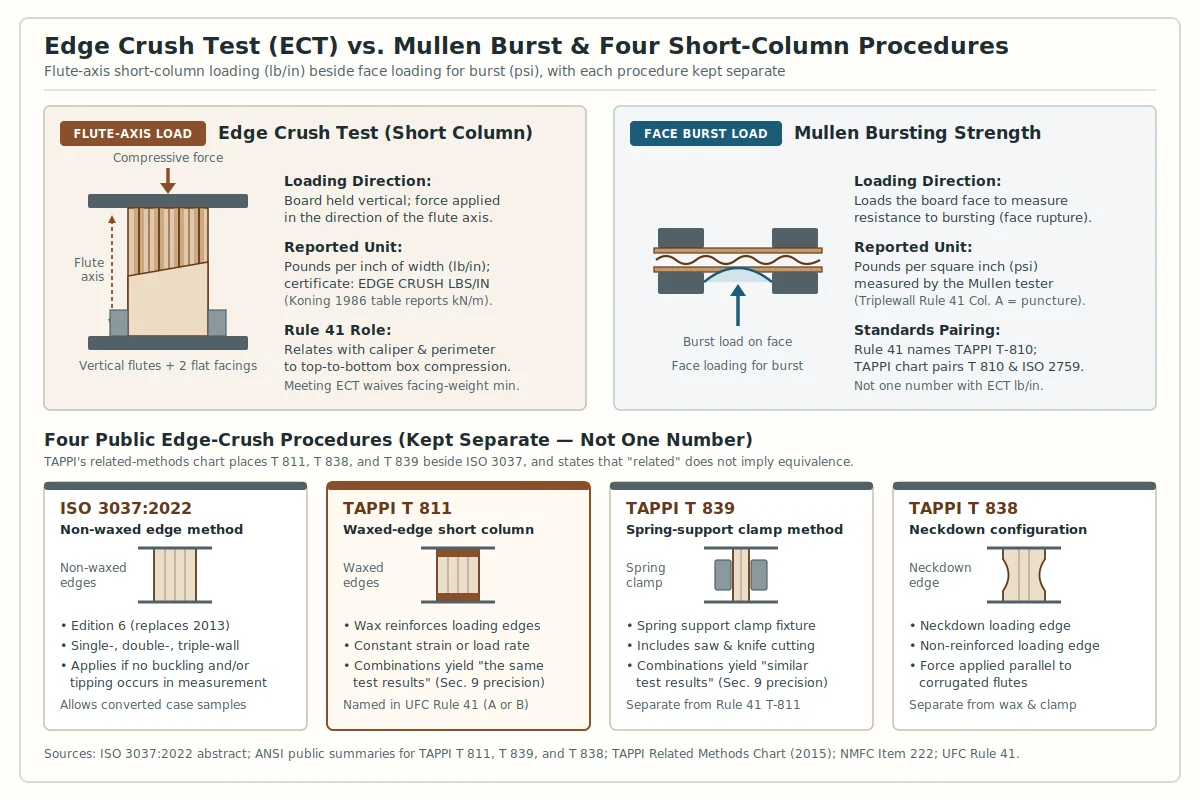
The edge crush test (ECT), also called the Short Column Test, loads a short column of corrugated fiberboard held vertical with the flutes oriented in the direction of loading and reports resistance in pounds per inch of width (lb/in). Mullen bursting strength loads the corrugated board face and reports resistance to bursting in pounds per square inch (psi) as measured by the Mullen tester. Specify the edge-crush path when the engineering question is top-to-bottom box compression and warehouse stacking, specify burst when the question is face rupture, and keep the two results separate because they are not one interchangeable number.
Sorting incoming cartons for packing or conversion follows our corrugated reuse workflow, which counts usable board and the handling it requires without treating every incoming box as available cushioning. When used multi-wall cartons are diverted to a perforator instead of reuse as shipping containers, match the powertrain, cutting throat, and dust collector to the heaviest incoming corrugated board grade as detailed in heavy-duty cardboard shredders for double-wall boxes.
What Does the Edge Crush Test Measure in Corrugated Board?
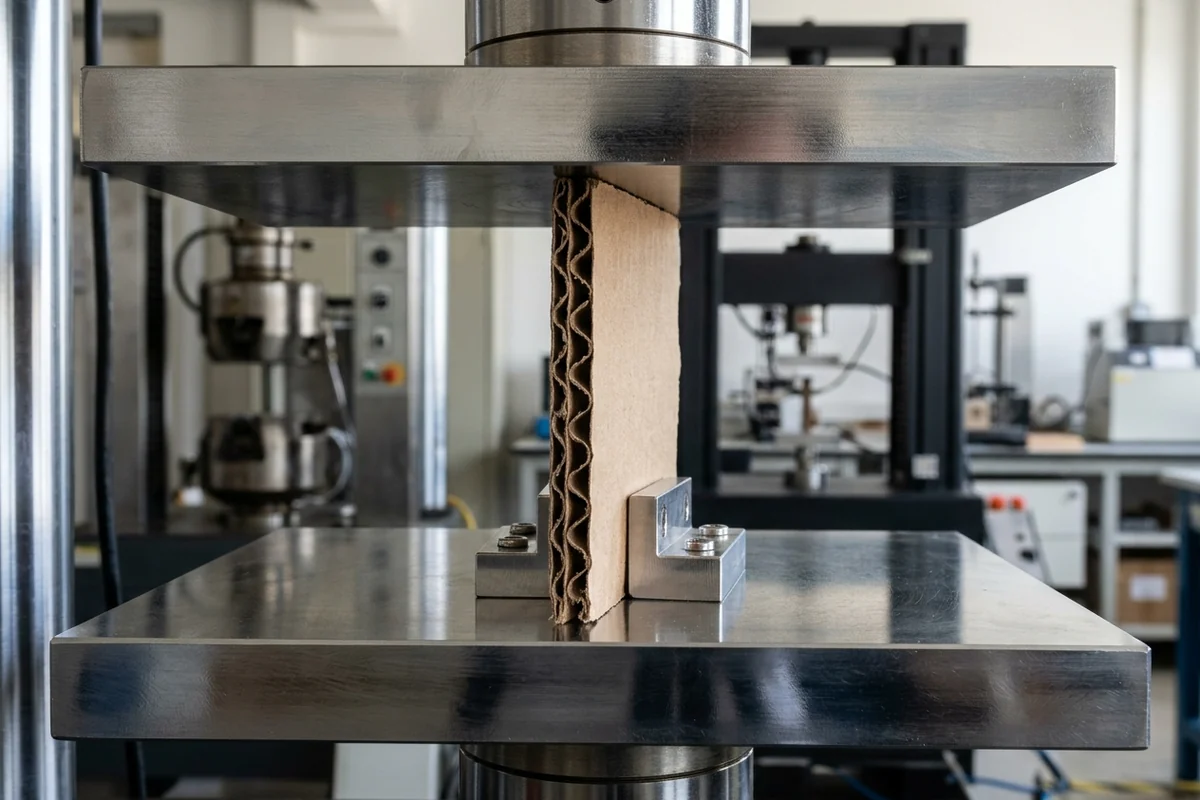
An ect corrugated measurement determines the edgewise compressive strength of a short column of combined board loaded parallel to the flutes. In NMFC Item 222, the specimen stands vertical with flutes oriented in the direction of loading and the result is measured as pounds per inch of width (lb/in). The UFC Rule 41 numbered-package edge-crush certificate is labeled EDGE CRUSH LBS/IN. The USDA Forest Products Laboratory comparison table reports compressive strength in kN/m, and that header is not a conversion from lb/in.
In ISO 3037:2022 (Edition 6, dated 2022-11, replacing the withdrawn ISO 3037:2013), compressive force is applied in the direction of the flute axis across single-wall (double-faced), double-wall, and triple-wall corrugated fibreboard, including test samples cut from corrugated cases and other converted products, provided no buckling and/or tipping occurs during measurement. NMFC Item 222 and UFC Rule 41 define singlewall as one corrugated inner medium (or member) glued between two flat facings, doublewall as three flat facings and two intermediate corrugated mediums (or members), and triplewall in Rule 41 as four flat facings and three intermediate corrugated members.
Mullen bursting strength evaluates a different failure mode under a separate standards family. Both NMFC Item 222 (whose glossary points Mullen Test to Bursting Strength) and UFC Rule 41 define bursting strength in pounds per square inch (psi) measured by the Mullen tester, and the TAPPI related-methods chart places T 810 (Bursting Strength of Corrugated and Solid Fiberboard) beside ISO 2759 while placing T 811 (the short column test), T 838 (neckdown), and T 839 (the clamp method short column test) beside ISO 3037.
How Is the Laboratory Edge Crush Test Method Performed?
Four standardized edgewise methods use different edge preparations, and the TAPPI related-methods chart notes that related does not imply equivalence, so a related standard should not be assumed to have identical technical content or matching results. ISO 3037:2022 specifies a non-waxed edge method; TAPPI T 811 specifies waxed edges on single-, double-, or triple-wall short columns loaded at a constant strain rate or constant load rate and states that any combination of its procedures yields the same test results within Section 9 precision; TAPPI T 839 uses a spring support clamp fixture with saw cutting and knife cutting and states that any combination of its procedures yields similar test results within Section 9 precision; and TAPPI T 838 uses a neckdown, non-reinforced loading edge configuration. When commissioning laboratory tests or requesting corrugated certificates from a box supplier, confirm the exact platen loading rate and Section 9 repeatability and reproducibility limits specified in the governing standard.
In the 1963 McKee and coauthors study, the regular rectangular column crush test was judged inadequate because it evaluated weakened loading edges rather than intrinsic board strength, and the necked-down column test yielded higher board-strength estimates on average than the regular column crush test for A-flute board in the cross-machine direction. In the Forest Products Laboratory paper (which noted short-column testing was generally run by TAPPI T 811 or T 823), wax reinforced the loading edges to prevent edge failure, whereas a European unwaxed specimen 25 mm high by 100 mm wide gave low values because of failure at the loading edges; that paper treated differences greater than 10% as practical significance because container compressive strength typically varies by 10%.
UFC Rule 41 is the rail box rule, and its edge-crush compliance tests must follow TAPPI Official Test Method T-811, A or B, on waxed-edge short columns. Burst compliance tests in Rule 41 must follow TAPPI Official Test Method T-810. In the copy-paper note, ECT is described as a high-variability measurement because it tests to failure and is subject to specimen flaws such as non-parallel edges or handling damage. A Rule 41 edge-crush set is a minimum of six tests. Only one may fall below the specified minimum, and that one cannot fall below it by more than 10%. Rule 41 accepts a failing edge-crush board on re-test when, in 24 tests, not more than four fall below the minimum and none of those falls below by more than 10%.
| Test Standard | Specimen Support & Edge Preparation | Scope & Cutting Details | Published Precision or Rule 41 Role |
|---|---|---|---|
ISO 3037:2022 (Edition 6, replaces ISO 3037:2013) |
Non-waxed edge method; force applied along the flute axis | Single-wall, double-wall, and triple-wall board plus converted case samples; valid if no buckling and/or tipping occurs | Listed beside T 811, T 838, and T 839 on the TAPPI chart ("Related" does not imply equivalence) |
TAPPI T 811 |
Short column supported on waxed edges; constant strain rate or constant load rate | Single-, double-, or triple-wall corrugated fiberboard parallel to the flutes | Combinations yield the same test results (Section 9 precision); named in UFC Rule 41 (T-811, A or B) |
TAPPI T 839 |
Spring support clamp fixture | Parallel to the flutes; includes saw cutting and knife cutting | Combinations yield similar test results (Section 9 precision); Urbanik and Frank kept waxed TAPPI T 811 data and clamped TAPPI T 839 data in separate subsets |
TAPPI T 838 |
Neckdown, non-reinforced loading edge configuration | Parallel to the flutes | Listed beside ISO 3037 on the TAPPI related-methods chart as a separate procedure |
How Does McKee’s Formula Link ECT to Box Compression?
The edgewise compression strength of corrugated board is a dominant factor in the compression strength of a box. Box compression strength is related to warehouse stacking performance. Top-to-bottom box compression strength is an important performance criterion for boxes that protect products stacked in warehouses or in transit. Recognized as the major combined-board property by McKee and coauthors in 1963, edge crush enters the Georgia Tech Renewable Bioproducts Institute derivation (which calls the 1963 McKee formula the simplest and most accurate predictor for box compression strength, used in commercial box design software with empirically based correction factors) by taking the compression-strength input Ps as ECT.
When container panels are short enough not to buckle, using the criterion that box height is at least Z/7 (where Z is the box perimeter), that derivation states that the box fails by compression only and writes BCT = C × ECT × Z (compression only). The sandwich-beam approximation makes BCT depend on the square root of the board caliper. For standard regular slotted containers (RSC), the simplified McKee formula relates top-to-bottom box compression strength (BCT, in lbf) to edge crush strength (ECT, in lb/in), combined-board caliper (t, in in), and box perimeter (Z = 2 × (L + W), in in) as BCT = 5.87 × ECT × √(t × Z)—which simplifies to BCT = 37.6 × ECT × t^0.5 for a 41-inch perimeter copy-paper box. For single-wall board the paper writes ECT = C (2 × SCTliner + 1.42 × SCTmedium), which is an illustration and not a certificate minimum. In the USDA Forest Products Laboratory review by Urbanik and Frank, Pm denotes the edge-crush value of the combined board, Z denotes the box perimeter, and Dx and Dy denote the flexural stiffness values of the combined board in each direction.
Published accuracy figures and fitted constants belong strictly to the data sets on which they were measured rather than acting as universal guarantees for a new carton:
- In the Urbanik and Frank review (which kept waxed
TAPPI T 811data and clampedTAPPI T 839data in separate subsets), McKee and coauthors’1963data set had a reported average difference of6.1%between predicted and actual compression strength, with97%of their data within±15%and a maximum difference of17.1%. - That review noted that the original McKee constants applied to its data sets were
a = 2.028andb = 0.746, concluded that inter-laboratory procedures do not support inferring thataandbare actually constant, and showed that increasingaby50%would lead to a50%increase in predicted box compression. - On the copy-paper box data set (
BCTinlbs,ECTinlb/inand caliper ininchesmeasured with theT 839clamp method, box perimeterZ = 41, and finished boxes compressed at a platen speed of one-half inch per minute), the fitted form had an average error of25%while the original McKee form had an average error of52%and overestimatedBCT. - In that same copy-paper study, machine-direction
ECTwas lower than cross-directionECTbyabout a factor of 2because the fluted medium does not contribute under a machine-direction load, andB-fluteboard in theT 839clamp failed by buckling in the machine direction compared with failing by compression in the cross direction. - In the 1963 McKee and coauthors study, the laboratory box compression test is an after-the-fact evaluation because it comes at the end of manufacturing and conversion, and the box compression test is generally not capable of distinguishing the several factors that contribute to box strength.

When Should Shippers Specify ECT Instead of Mullen Burst?
Specify the edge-crush path when the question is top-to-bottom box compression, and specify Mullen burst when the question is face rupture. Rule 41 labels triplewall Column A as a minimum puncture test in inch ounces per inch of tear, which is not a burst pressure in psi. UFC Rule 41 requires corrugated boxes to comply with the burst, puncture, or edge crush test and the other requirements in Section 3, states that edgewise compressive strength together with combined-board caliper and container perimeter relates to top-to-bottom compressive strength, and specifies that where board meets the minimum edge crush test, the table’s minimum combined weight of facings does not apply.
Keep rail and motor-freight classification tables separate from each other and from parcel pre-shipment testing. According to ISTA, UFC Rule 41 (the rail box rule) and NMFC Item 222 (the common-carrier motor-freight box rule) are similar but not identical, their certificate minimums specify board construction and material properties relative to box size and gross weight limits without necessarily addressing product damage and protection or applying to other modes of transport, and there is no way to compare or correlate Rule 41 and Item 222 to ISTA pre-shipment performance tests (where pass/fail criteria are set by the product manufacturer). Consistent with that boundary, our on-demand corrugated box-sizing guide notes that material specifications alone do not guarantee a well-made box without pack validation, and our cardboard cushioning packaging guide treats reused cardboard as a candidate material until the assembled pack is tested against stated acceptance criteria, noting that an ISTA screening result can help eliminate weak concepts without representing the procedure selected for the intended shipment.
In UFC Rule 41 Section 3, the rule defines both main-table construction rows and an alternate table pairing Column A (psi bursting test for singlewall and doublewall, but inch oz per inch of tear minimum puncture test for triplewall) with Column B (lbs per inch width minimum edge crush test):
| UFC Rule 41 Wall Construction | Max Box & Contents Weight (lbs) |
Max Outside Dimensions (in) |
Min Combined Facing Weight (Burst Path) | Column A: Min Burst (psi) or Triplewall Puncture |
Column B: Min Edge Crush (lbs/in width) |
|---|---|---|---|---|---|
| Singlewall (main row & alternate pair) | 20 |
40 |
52 (waived on ECT path) |
125 psi burst |
23 lbs/in |
| Singlewall (main row & alternate pair) | 65 |
75 |
84 (waived on ECT path) |
200 psi burst |
32 lbs/in |
| Singlewall (alternate table pair) | See Rule 41 Section 3 class row | See Rule 41 Section 3 class row | Waived where ECT min is met | 275 psi burst |
44 lbs/in |
| Singlewall (main row & alternate pair) | 120 |
105 |
180 (waived on ECT path) |
350 psi burst |
55 lbs/in |
| Doublewall (main row & alternate pair) | 80 |
85 |
92 (waived on ECT path) |
200 psi burst |
42 lbs/in |
| Doublewall (alternate table pair) | See Rule 41 Section 3 class row | See Rule 41 Section 3 class row | Waived where ECT min is met | 350 psi burst |
51 lbs/in |
| Triplewall (main row & alternate pair) | 240 |
110 |
168 (waived on ECT path) |
700 inch oz per inch of tear puncture |
67 lbs/in |
How Do You Read Edge Crush Ratings on Box Certificates?
A Box Manufacturer’s Certificate (BMC) under NMFC Item 222 is a circular or rectangular border printed on an outside surface of a fiberboard box, carrying the box manufacturer’s name and location and certifying that the applicable Item 222 construction requirements have been met (boxes may bear the circular certificate only when Item 222 provisions are met). Both NMFC Item 222 and UFC Rule 41 specify a 3-inch diameter, plus or minus 1/4 inch, while Item 222 allows a smaller outside diameter of not less than two inches on boxes shorter than ten inches in length or narrower than nine inches in width.
Edge-crush certificates under NMFC Item 222 comply with the edge crush test and Table B (and UFC Rule 41’s numbered-package edge-crush stamp prints EDGE CRUSH LBS/IN). Under NMFC Item 222, the test stated in the certificate must be not less than the minimum required for the gross weight and dimension limit (an actual test above that minimum may be stated below the certificate), multi-part fiberboard boxes must state the lowest represented bursting test or edge crush test of any given part, and a fiberboard master pack’s gross weight must not exceed 4 times the allowable gross weight for the lowest burst or edge crush test of any component. When the size-extension formula applies, Rule 41 allows the gross-weight limit to be omitted and requires Size Extension Formula to be printed below the certificate.
Use the checklist below to separate a unitized pallet stack from a single-piece parcel shipment before releasing a carton specification:
| Specification Check | Unitized Pallet Stack (Rail / Motor Freight) | Single-Piece Parcel Shipment |
|---|---|---|
| Governing rule & certificate type | Verify whether rail (UFC Rule 41) or common-carrier motor freight (NMFC Item 222, Table B for ECT) applies; keep the two carrier rules separate and check the 3-inch (± 1/4 in) outside mark (or not less than two inches on boxes less than ten inches long or less than nine inches wide) |
Carrier Rule 41 and Item 222 minimums do not apply to other modes of transport; treat a printed BMC as a board-material baseline rather than parcel qualification |
Edge-crush (lb/in) vs burst (psi) minimum |
Select the ECT path (TAPPI T-811, A or B, in Rule 41; certificate label EDGE CRUSH LBS/IN) when the question is top-to-bottom box compression, which Rule 41 relates to combined-board caliper and the container perimeter, or select TAPPI T-810 Mullen burst in psi when the question is face rupture; triplewall Column A remains a puncture test in inch oz per inch of tear |
Confirm the test stated in the certificate is not less than the minimum required for the gross weight and dimension limit, and an actual test above that minimum may be stated below the certificate |
| Multi-part lowest component & master-pack cap | Confirm the certificate states the lowest represented burst or edge crush test of any fiberboard part, and keep master-pack gross weight at or below 4 times the allowance for that lowest component |
Test the assembled pack against stated acceptance criteria rather than treating the outer-wall board grade as pack validation |
| Combined facing-weight waiver & size extension | On the UFC Rule 41 ECT path, the table’s minimum combined weight of facings does not apply where board meets the minimum edge crush test; when the size-extension formula applies, Rule 41 allows the gross-weight limit to be omitted and requires Size Extension Formula to be printed below the certificate |
Do not read an ECT stamp as a combined-facing-weight minimum, and do not treat an omitted gross-weight limit as an unlimited box |
| ISTA pre-shipment pack test check | Run an ISTA pre-shipment test when evaluating product damage and protection against pass/fail criteria set by the product manufacturer, because Rule 41 and Item 222 have no correlation to ISTA pre-shipment performance tests |
Test the assembled pack against pass/fail criteria set by the product manufacturer (an ISTA screening result can help eliminate weak concepts and should not be represented as the procedure selected for the intended shipment) |