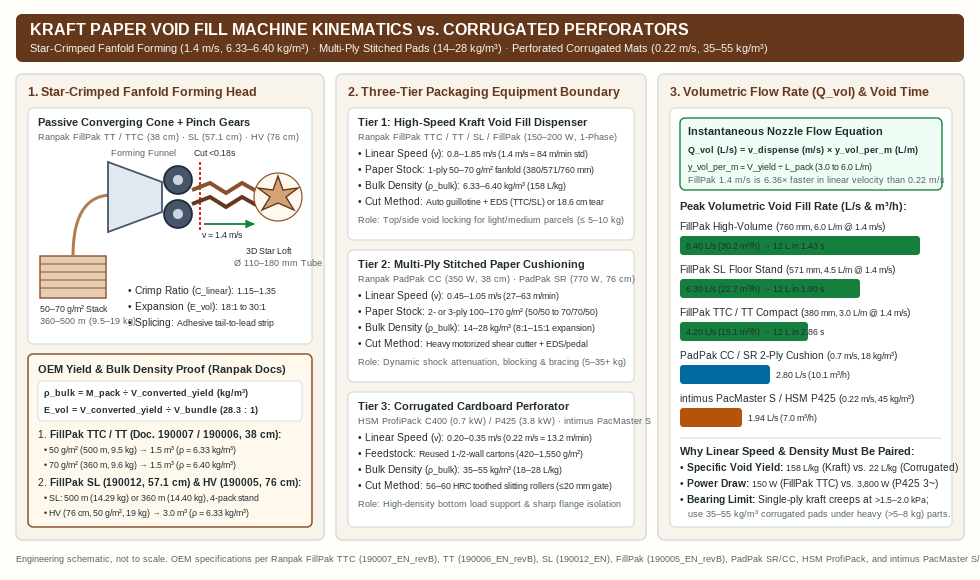
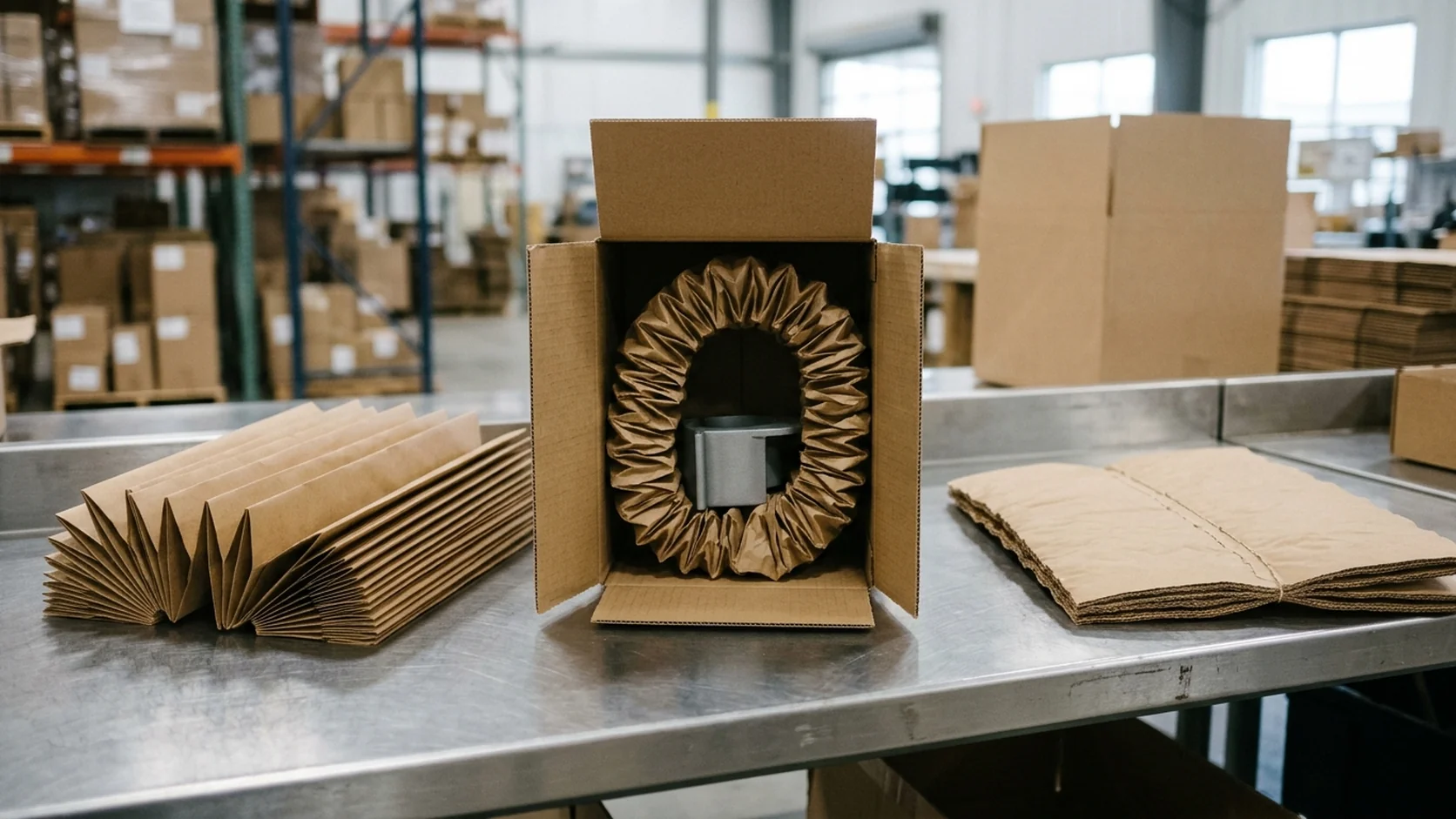
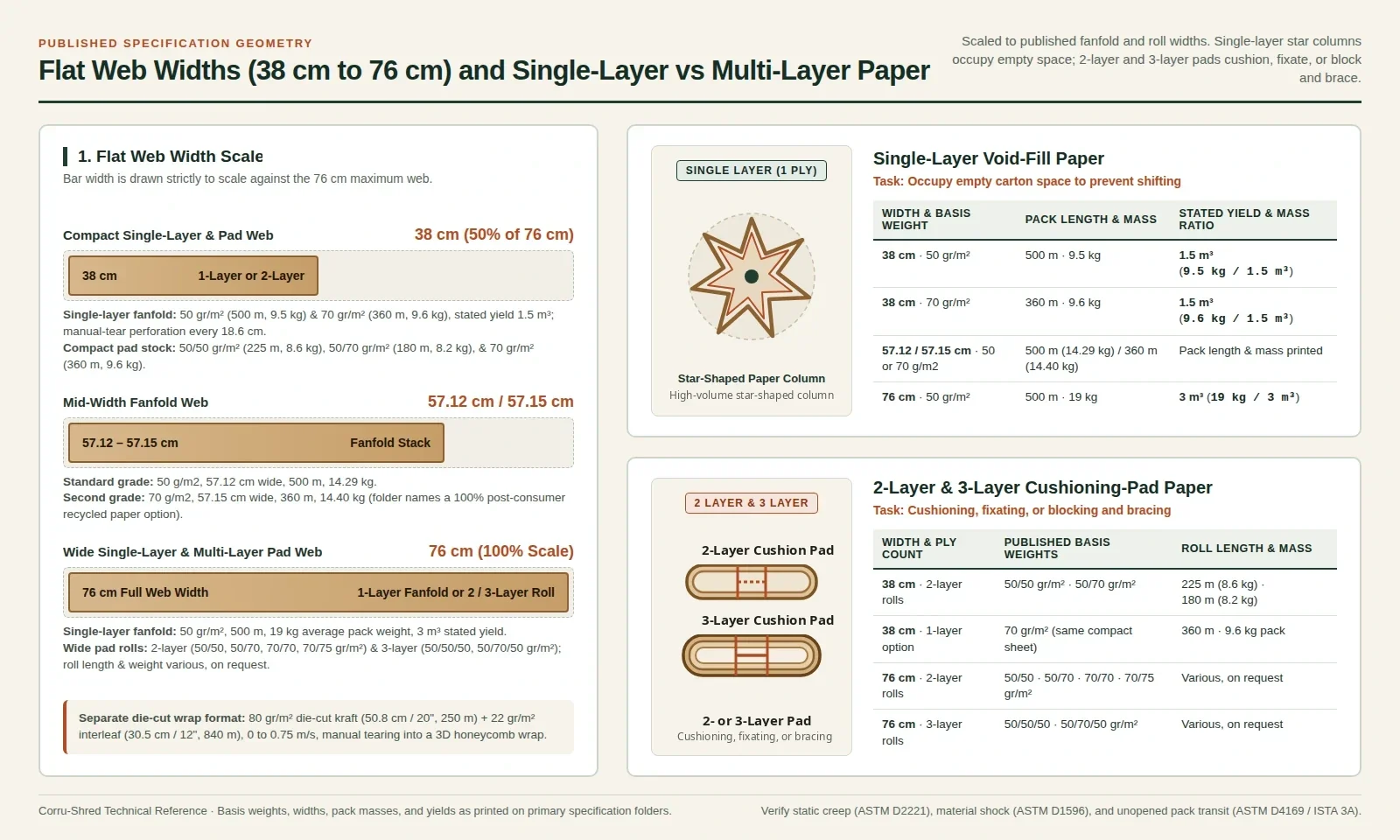
Single layer kraft void fill paper converts from flat fanfold stacks into a high-volume star-shaped paper column that fills open carton space so packed goods do not shift in transit. Published 38 cm single-layer specifications pair 50 gr/m² at 500 m (9.5 kg average pack weight) and 70 gr/m² at 360 m (9.6 kg average pack weight) at the same 1.5 m³ average yield, mid-width fanfold sheets list 50 g/m² at 57.12 cm (500 m, 14.29 kg) and 70 g/m² at 57.15 cm (360 m, 14.40 kg), and wide 76 cm single-layer fanfold lists 50 gr/m² at 500 m (19 kg) for a 3 m³ average yield.
Matching basis weight, roll width, and ply count to the carton follows the boundary set in our void-fill machinery hub, which separates void filling, restraint, and cushioning when defining a packing task. Under USPS DMM 601 section 3.1.1 and section 3.13, mailers must package contents so they do not shift inside the mailing container, overfill loose-fill cushioning before closure, cushion fragile items, and brace and cushion heavy items while also stabilizing them; stepping from one layer to 2 or 3 layer kraft paper moves the pack from space-filling star columns to pads built for cushioning, fixating, or blocking and bracing.
What Is Void Fill Paper and How Does It Differ from Cushioning?
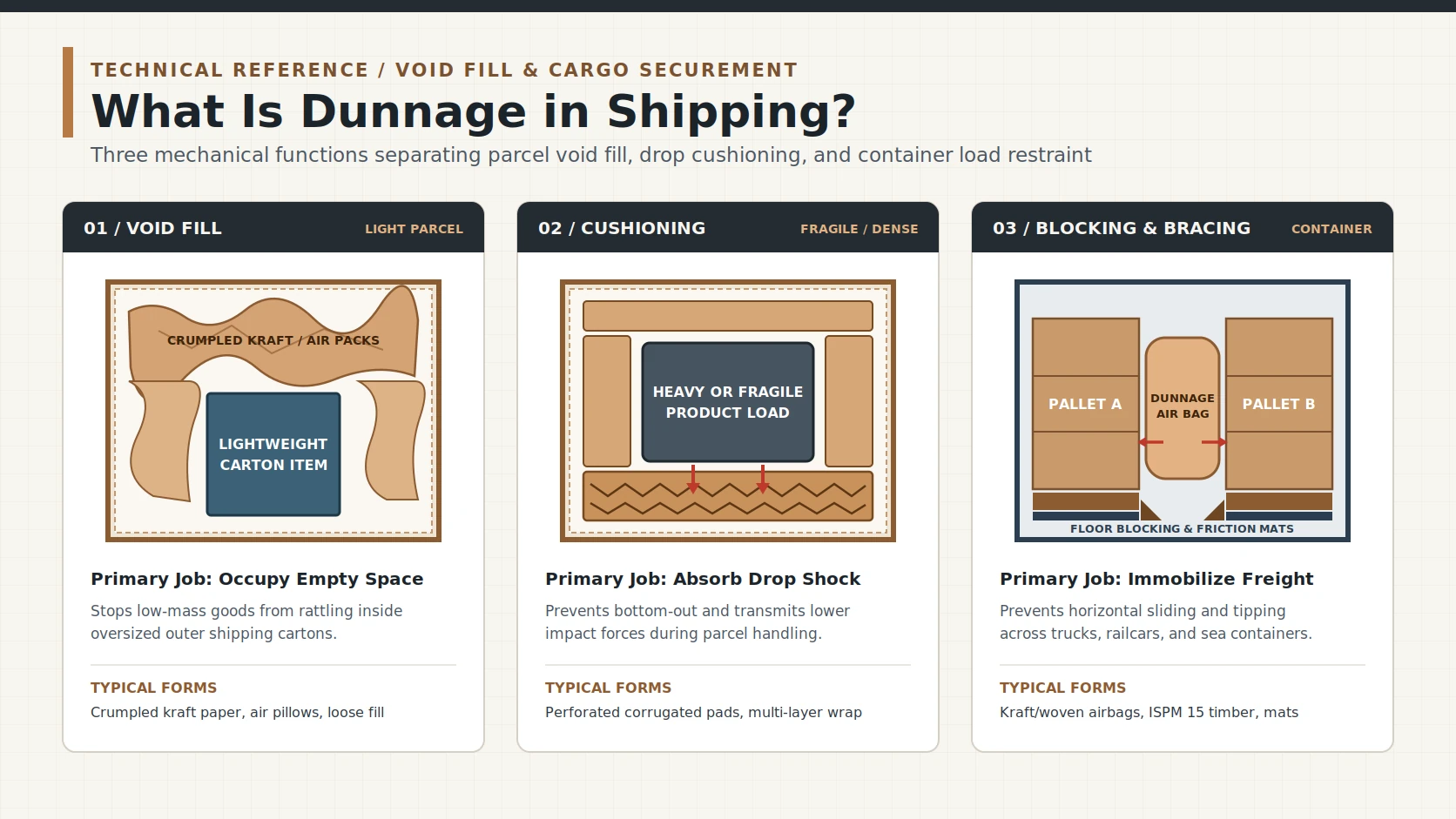
Void fill occupies unused space inside a shipping carton, restraint limits product movement, and cushioning manages the handling loads transmitted to the product, as defined in our cardboard cushioning packaging reference. Single layer kraft paper forms a high-volume star-shaped filling column that keeps items from shifting around in their box, and the manual-tear 38 cm single-layer specification spaces cross-web perforations every 18.6 cm so packers can separate formed lengths by hand.
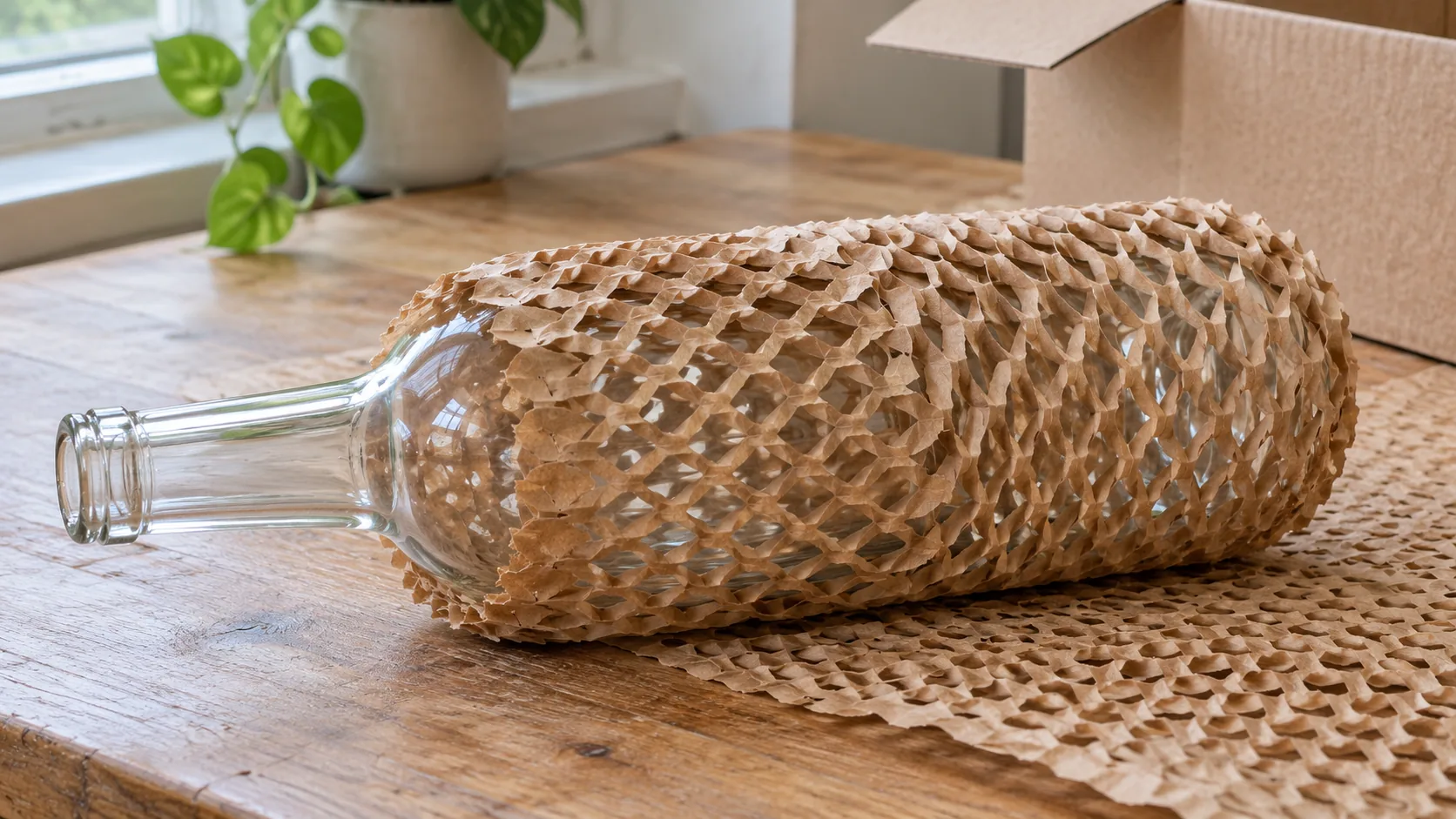
Expanded paper surface wraps and perforated corrugated pads solve different bench tasks even when they sit alongside a void fill system. Published die-cut wrap specifications pair an 80 gr/m² die-cut kraft roll (250 m roll length, 50.8 cm or 20" paper width) with a 22 gr/m² interleaf roll (840 m roll length, 30.5 cm or 12" paper width), expanding the web at 0 to 0.75 m/s with manual tearing into a 3D honeycomb structure whose angled cells lock around an item without tape; compare surface-wrap versus corrugated-mat roles in honeycomb paper wrap vs shredded cardboard cushioning, and review converter throughput and bench reach in Paper Void Fill Machine Dispensing Speed and Ergonomics.
Which Basis Weight and Web Width Fit Your Void Fill System?
Flat paper width (38 cm, 57.12 cm or 57.15 cm, or 76 cm) matches the converter feed path while leaving adequate carton clearance around the packed item. USPS DMM 601 permits solid and corrugated fiberboard boxes for loads up to 70 pounds provided the box is large enough to hold the contents and leave enough space for cushioning material.
Checking pack mass divided by the stated average yield verifies how basis weight and web width interact across single-layer fanfold grades. For 38 cm single-layer fanfold, dividing the 9.5 kg average pack weight of the 50 gr/m² (500 m) pack by its 1.5 m³ stated average yield (9.5 kg / 1.5 m³) sits right beside the 70 gr/m² (360 m) pack at 9.6 kg / 1.5 m³, because the heavier basis weight shortens pack length from 500 m to 360 m while keeping pack mass and stated 1.5 m³ yield nearly identical; doubling flat web width to 76 cm at 50 gr/m² and 500 m doubles both average pack weight and average yield to 19 kg / 3 m³.
When writing a purchase specification for packaging void fill or cushioning paper, record basis weight (GSM), ply count, flat web width, pack or roll length, pack mass, expected expanded yield, and any declared recycled-fiber share such as a 100% post-consumer recycled paper grade. For 57 cm mid-width fanfold stock (50 g/m² at 57.12 cm, 500 m, 14.29 kg; and 70 g/m² at 57.15 cm, 360 m, 14.40 kg), confirm the expanded cubic-meter yield directly with your paper supplier, and for 76 cm multi-layer cushioning rolls verify exact roll length and roll weight against the converter specification sheet.
Use the selection table below to match your measured item mass and open carton void volume against the published paper rows before running a packout trial.
| Paper Format and Web Width | Basis Weight and Ply Structure | Pack or Roll Length and Mass | Stated Average Yield | Item Mass, Carton Void Volume, and Packout Check |
|---|---|---|---|---|
Compact fanfold void fill (38 cm) |
Single layer 50 gr/m² (automatic cut, or manual tear with perforation every 18.6 cm) |
500 m pack length; 9.5 kg average pack weight |
1.5 m³ (9.5 kg / 1.5 m³) |
Record item mass and open void volume; overfill top and side cavities before closure so contents cannot shift |
Compact fanfold void fill (38 cm) |
Single layer 70 gr/m² (automatic cut, or manual tear with perforation every 18.6 cm) |
360 m pack length; 9.6 kg average pack weight |
1.5 m³ (9.6 kg / 1.5 m³) |
Record item mass and open void volume; match the 70 gr/m² basis weight (360 m, 9.6 kg) to specifications calling for 70 gr/m² single-layer stock at 1.5 m³ yield |
Mid-width fanfold void fill (57.12 cm and 57.15 cm) |
Single layer 50 g/m² (57.12 cm) or 70 g/m² (57.15 cm, includes 100% post-consumer recycled option) |
500 m at 14.29 kg (50 g/m²) or 360 m at 14.40 kg (70 g/m²) |
Confirm expanded yield on supplier datasheet | Record item mass and open void volume; verify the mid-width web fits the converter and confirm recycled-fiber percentage by weight |
Wide fanfold void fill (76 cm) |
Single layer 50 gr/m² |
500 m pack length; 19 kg average pack weight |
3 m³ (19 kg / 3 m³) |
Record item mass and open void volume; size for large carton cavities fed by a 76 cm single-layer converter |
Compact cushioning pad stock (38 cm) |
1 and 2 layer options: 50/50 gr/m², 50/70 gr/m², or single-sheet 70 gr/m² |
225 m at 8.6 kg (50/50 gr/m²); 180 m at 8.2 kg (50/70 gr/m²); 360 m at 9.6 kg (70 gr/m²) |
Pad output follows pack length and converter fold settings | Record item mass and carton clearance; match 1 or 2 layer pads to light or heavy products on compact benches |
Wide cushioning pad stock (76 cm) |
2 or 3 layer options: 50/50 gr/m², 50/70 gr/m², 70/70 gr/m², 70/75 gr/m², 50/50/50 gr/m², 50/70/50 gr/m² |
Varies by roll configuration (confirm roll length and weight with supplier) | Pad output set by cushioning, fixating, or blocking and bracing layout | Record item mass, bearing area, and void clearance; verify pad thickness retention under static load and transit drops |
Die-cut surface wrap (50.8 cm / 20" with 30.5 cm / 12" interleaf) |
80 gr/m² die-cut kraft plus 22 gr/m² tissue interleaf (0 to 0.75 m/s, manual tearing) |
250 m die-cut roll; 840 m interleaf roll |
Expands to a 3D honeycomb wrap without tape |
Record item surface fragility and dimensions; lock angled honeycomb cells around individual items and separate multi-item packs |
When Should You Step Up from Single-Layer Fill to Multi-Layer Pads?
Step up from single-layer star fill to multi-layer kraft pads whenever the packed product requires load-bearing cushioning, fixating, or blocking and bracing rather than empty-space filling. On the 38 cm compact cushioning specification, both 1 and 2 layer paper is available (50/50 gr/m² at 225 m and 8.6 kg, 50/70 gr/m² at 180 m and 8.2 kg, alongside 70 gr/m² at 360 m and 9.6 kg) so light or heavy products can be packed on one converter footprint, while the 76 cm wide cushioning specification converts 2 or 3 layer paper (50/50 gr/m², 50/70 gr/m², 70/70 gr/m², 50/50/50 gr/m², 50/70/50 gr/m², and 70/75 gr/m²) into pads for blocking and bracing.
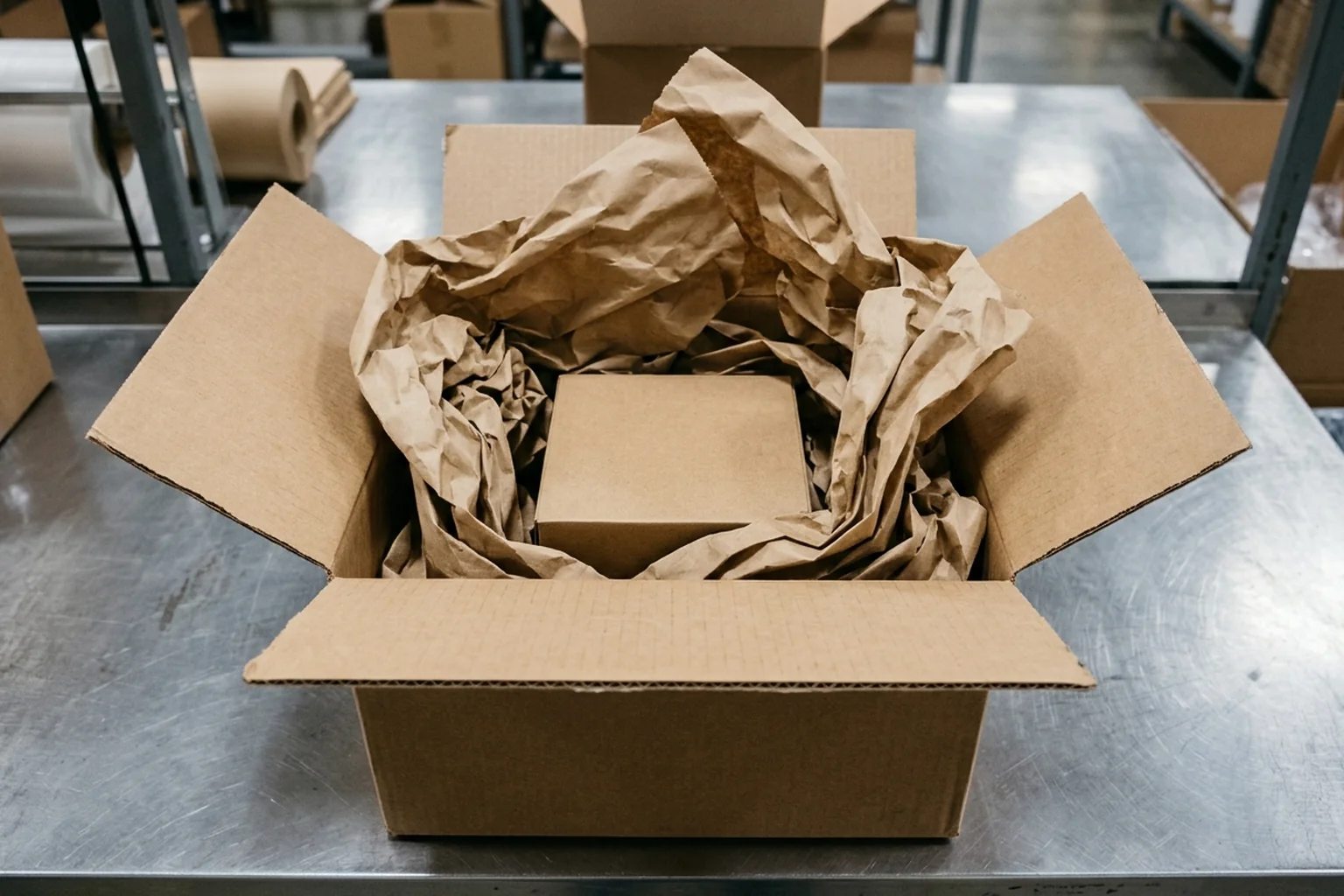
Box preparation at the station determines whether crumpled paper holds its geometry once flaps are taped shut. Under USPS DMM 601, individual mailpieces cannot exceed 70 pounds or 130 inches in combined length plus girth, loose-fill cushioning must overfill the container before closure to hold the item and prevent movement, multiple items in one container must be cushioned from each other as well as from external forces, and high-density heavy items should not share a carton with fragile items unless separated with extreme care.
Which Lab Tests Check Static Creep, Shock, and Parcel Transit?
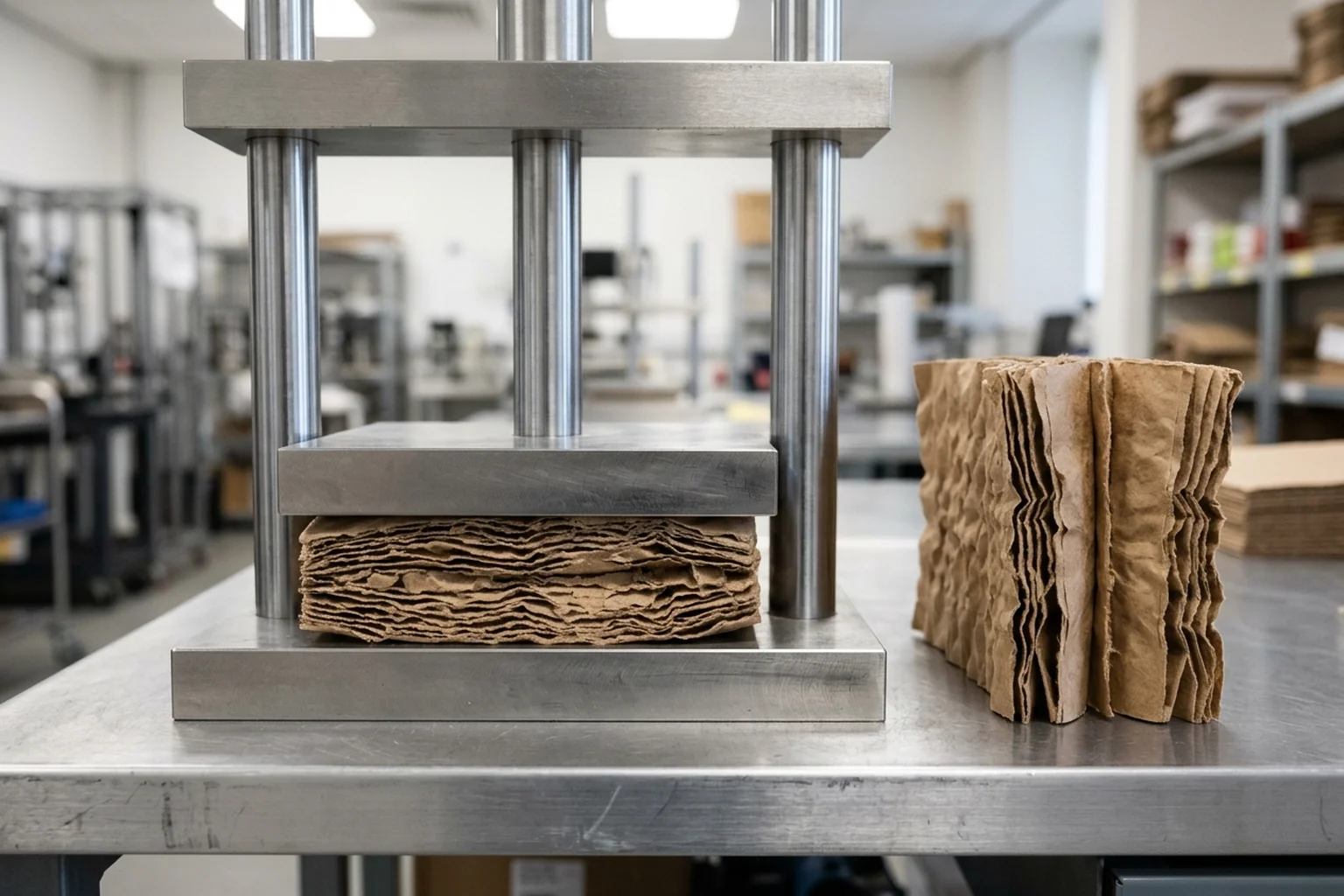
Validating a paper packout requires pairing material-level creep and shock methods with a sequential distribution test on the sealed shipping container. To measure whether crumpled kraft settles under sustained weight in storage or stacked transit, ASTM D2221-01(2021) determines the extent and nature of cushion thickness change under static load across bulk, sheet, or molded cushioning materials, noting that creep results depend on static load magnitude, specimen area, shape, actual cushion thickness, temperature, humidity, platen guide friction, and nearby vibration and do not necessarily match a complete pack.
For impact characterization, ASTM D1596-14(2021) records dynamic shock cushioning acceleration-time data by dropping a falling guided platen assembly onto a motionless sample; because it excludes the exterior box and applies only to the material sample, final qualification relies on unopened container testing. ASTM D4169-22 (and the current D4169-23e1 revision) subjects the same unopened shipping unit to a sequential plan of anticipated distribution hazards without supplanting material specifications, while ISTA 3-Series general simulation tests combine shaped random vibration, varied drop heights, and atmospheric conditioning under Procedure 3A for parcel delivery shipments of 150 lb (70 kg) or less, alongside Procedure 1A integrity testing for 150 lb (68 kg) or less.
Is Void Fill Paper Recyclable Under EPA Data and FTC Guides?
Corrugated shipping cartons and non-corrugated paper packaging post sharply different municipal recovery rates in federal statistics. According to EPA paper and paperboard data, paper and paperboard generated 67.4 million tons (23.1 percent of municipal solid waste) in 2018 with approximately 46 million tons recycled (68.2 percent overall), yet corrugated boxes reached a 96.5 percent recycling rate while paper containers and packaging excluding corrugated boxes recorded a 20.8 percent recycling rate.
Marketing recyclability or recycled fiber content on outbound void fill paper is governed by the Federal Trade Commission Green Guides. Under 16 CFR 260.12, marketers can make an unqualified recyclable claim when established recycling facilities are available to a substantial majority (at least 60 percent) of consumers or communities where the item is sold and the entire package excluding minor incidental components is recyclable without any recycling-limiting component, whereas marketers should qualify recyclable claims below 60 percent access (labels such as “Recyclable where facilities exist” are deceptive when fewer than 60 percent of communities nationwide have access). Under 16 CFR 260.13, recycled-content claims apply only to pre-consumer or post-consumer material diverted from the waste stream, marketers should qualify partial recycled content by weight percentage (such as 50% recycled fiber, or 50% total recycled fiber including 30% post-consumer fiber when 30% is post-consumer and 20% is pre-consumer, whereas an entire recycled sheet such as a 100% post-consumer recycled paper grade supports an unqualified claim), and an unexplained three-chasing-arrows symbol should be qualified unless the marketer has substantiation that the packaging is both recyclable and made entirely from recycled material.