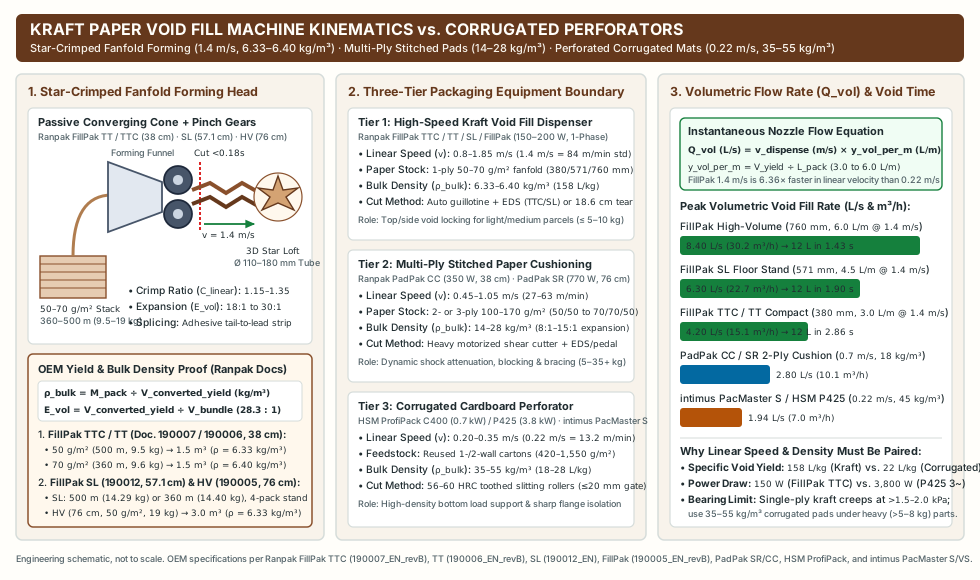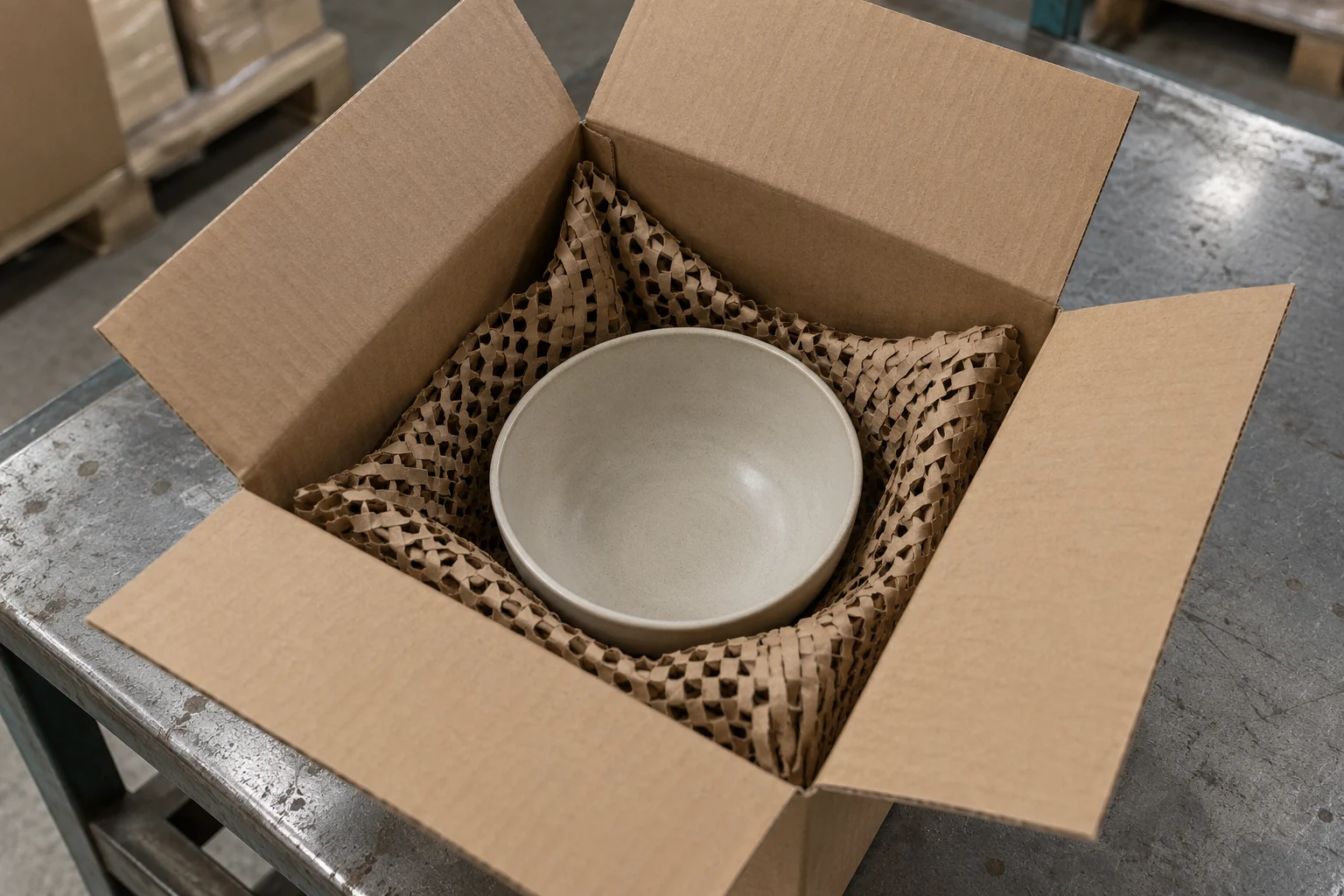
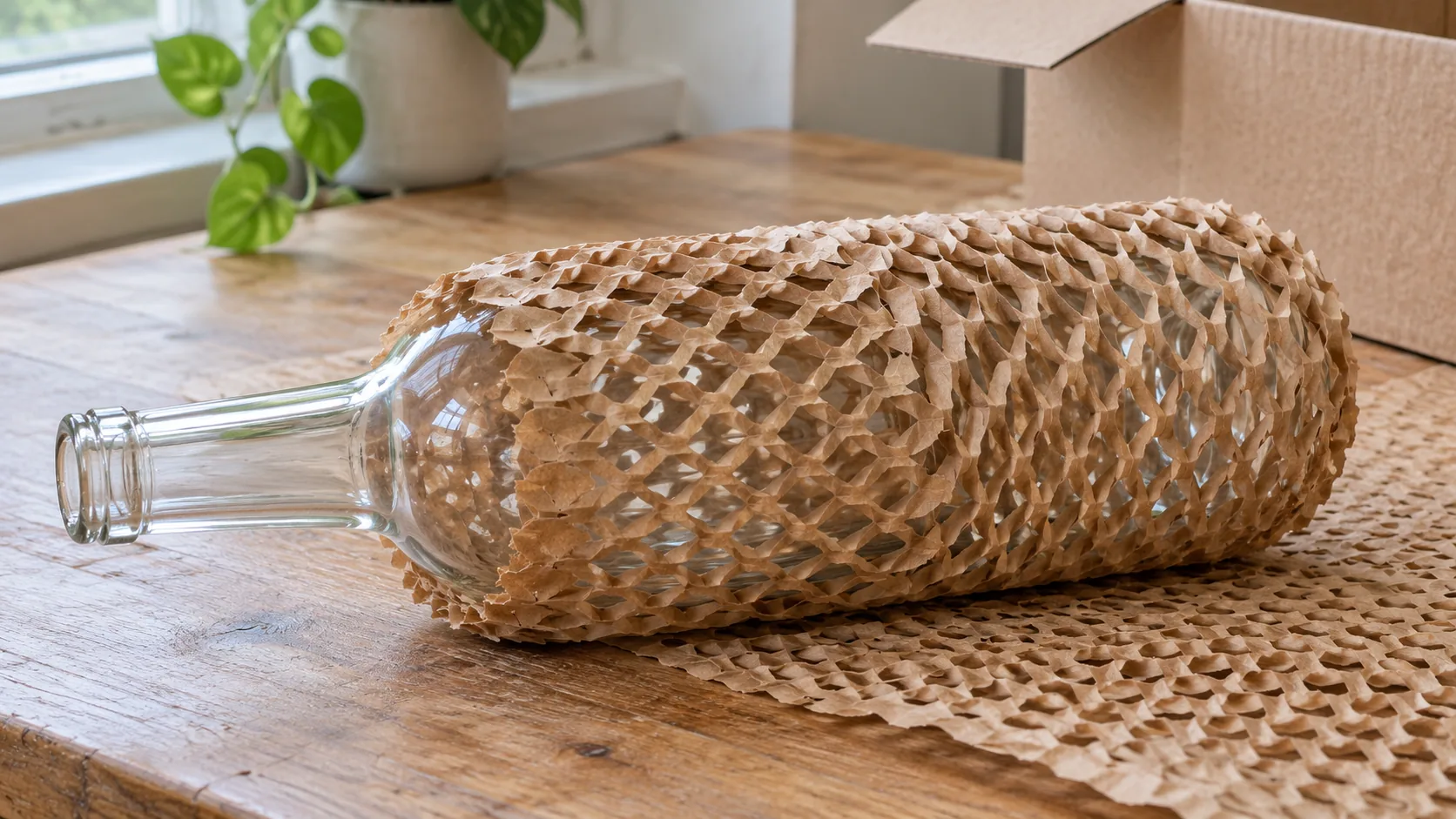
A honeycomb paper wrap and a shredded cardboard pad can share a carton and still be the wrong material for the job. The wrong choice damages a glazed surface or leaves a void that never holds the item.
The wrap is an expanded die-cut web. The pad is perforated used board. A converter speed in metres per second and a shredder rate in kilograms per hour are not the same measurement, so the larger nameplate is not the better cushion.
Two outputs, two jobs
Ranpak’s Geami WrapPak HV folder, document 190011_EN_revC, describes a die-cut kraft paper plus a tissue interleaf. The converter expands the die-cut sheet into a three-dimensional honeycomb. Locking the angled cells wraps the item, and that folder says no tape is needed for the lock. The die-cut paper on that sheet is 80 g/m², 250 m on the roll, and 50.8 cm wide. The interleaf is 22 g/m², 840 m, and 30.5 cm wide. The converter is 71.2 × 50.8 × 43.2 cm, 31 kg, 100–240 V, and 320 W.
The Brangs + Heinrich flyer for the same WrapPak HV, version 2 dated June 2023, states the expansion as 1.68 times into that honeycomb. The converter figures on the flyer match the Ranpak folder.
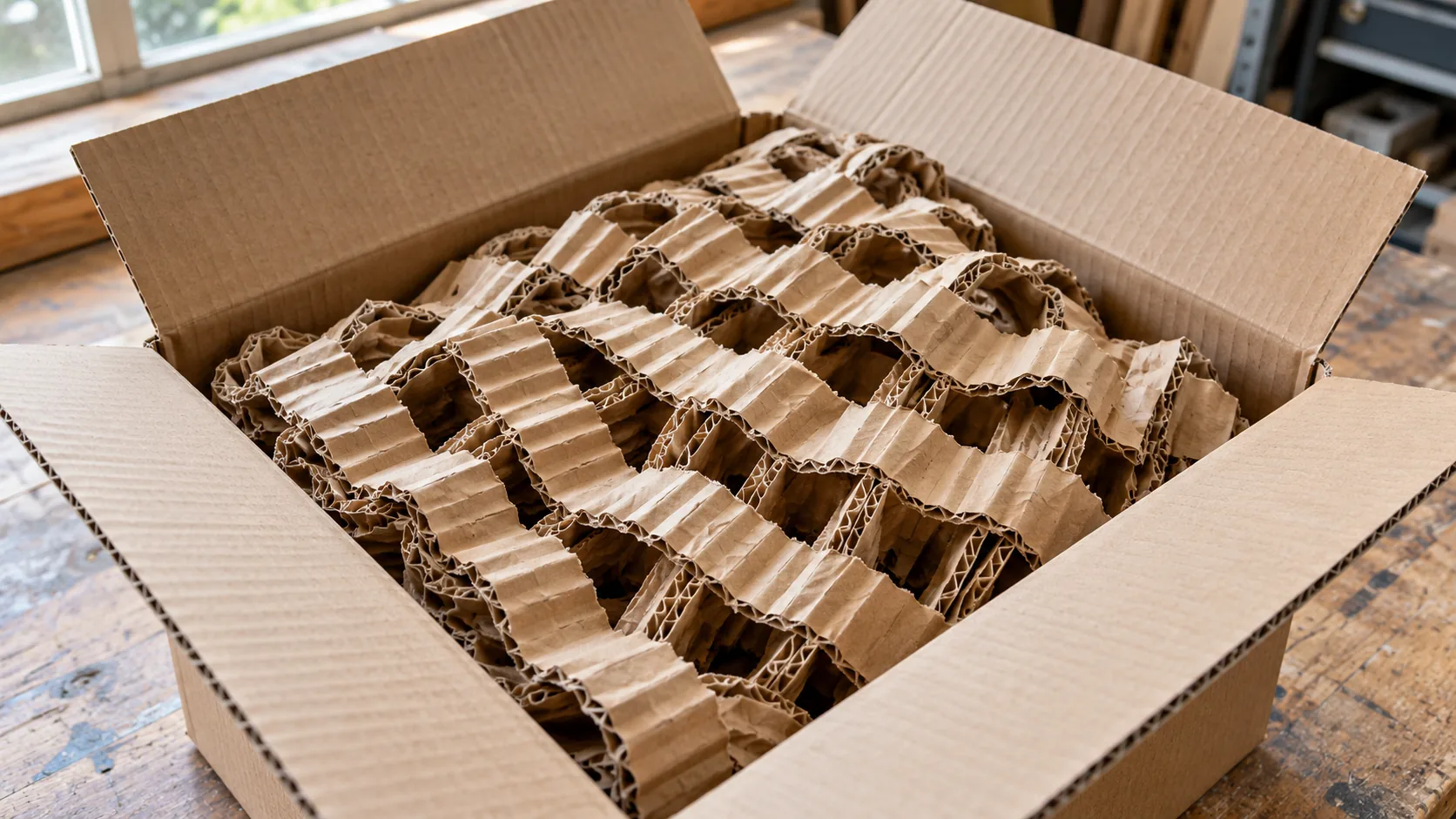
HSM’s ProfiPack overview describes a different output: used corrugated board cut into packaging cushions. The C400 is the tabletop unit for single-layer cushions, with a 415 mm working width, one layer up to 10 mm high, and a throughput up to 50 kg/h at 0.7 kW. Its packaging example uses a 1,000 × 415 mm BC sheet to fill a carton of 40 × 30 × 20 cm to 50 percent.
| Output | What it is | Nameplate | Dominant failure | Prevention |
|---|---|---|---|---|
| Honeycomb wrap | Die-cut kraft plus tissue, expanded 1.68× | 0 to 0.75 m/s, manual tear | Flat web stuffed in as loose fill | Expand it and lock the cells around the item |
| Perforated pad | Used board, C400 single layer | up to 50 kg/h | Pad face rubbed on a glaze | Fill the void; keep the flute off the glass |
| Station time | Full bench cycle | Neither nameplate | Quoting only the machine seconds | Add the tear, the sheet feed, and the place-in-box |
| Load path | Who carries the part | No drop result in either file | Asking the wrap to be the shipping structure | Sit the part on the carton and size the void with pads |
The dispenser speed is converter motion
Rule. If the quoted speed is 0.75 m/s, that is the top of the range in the Ranpak folder, written as “from 0 to 0.75 m/s”. The cut method on the same block is manual tearing. The tear is outside that speed.
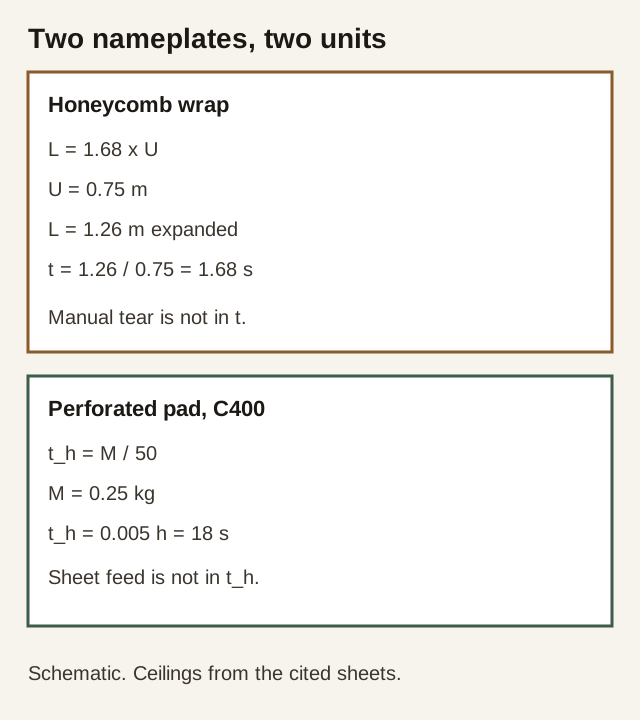
t = L / v
Take an unexpanded pull U = 0.75 m. The 1.68 factor makes the expanded length
L = 1.68 × 0.75 = 1.26 m
At the stated maximum,
t = 1.26 / 0.75 = 1.68 s
That 1.68 s is converter motion for this example pull. It is not the time to wrap the bottle, tear the web, or close the carton. A honeycomb packing paper dispenser comparison that stops at 1.68 s understates the bench.
The roll in both WrapPak HV sheets is 250 m unexpanded. At the same factor the expanded length of that roll is
L_roll = 1.68 × 250 = 420 m
That is web on the roll, not 420 m of protection. The Ranpak folder states the unexpanded width as 50.8 cm and does not print an expanded width, so this page does not add one.
The shredder ceiling is mass, not a wrap
Rule. If the C400 figure in use is 50 kg/h, that is a mass ceiling for single-layer cushions, not a length of wrap. Dividing 50 kg/h by 0.75 m/s does not produce a winner.
t_h = M / 50
For an example mass M = 0.25 kg of perforated board, at that ceiling,
t_h = 0.25 / 50 = 0.005 h = 18 s
Eighteen seconds is machine production at the published ceiling, before anyone carries a used sheet to the intake. HSM’s own hour-scale example stays as printed: one hour of C400 filling material, from the 1,000 × 415 mm BC sheet that fills a 40 × 30 × 20 cm carton to 50 percent, is presented as enough for 480 such parcels.
The P425 rows are higher ceilings: up to 80 kg/h on alternating current and up to 120 kg/h on three-phase current, each with up to three layers and a maximum layer height of 20 mm. The overview recommends the C400 for occasional single-layer cushions. The 120 kg/h row is still a pad.
Glass wants the interleaf. A heavy part wants the carton floor
The tissue interleaf is the surface layer in the WrapPak description. The honeycomb is the expanded die-cut web. A glazed bottle or a ceramic rim is the wrap’s job: a continuous sheet around the item, cells locked, tissue toward the surface.
A perforated pad is a volume filler. The flutes and the slit edges are what hold a gap open. Pressing that face against glass is the abrasion case. The pad belongs in the void around an item that already has its surface wrap, or around a part whose surface can tolerate the board.
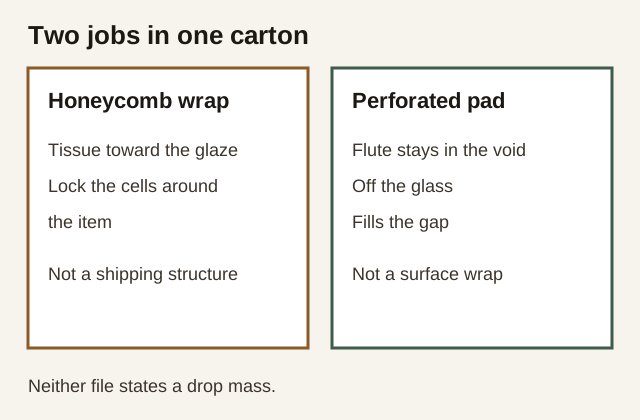
A part that sits on the carton floor is not held up by the honeycomb lock. If the part’s weight goes into the carton, the pad’s job is the gap, and the wrap’s job, if it is used at all, is the surface. Paper cushioning versus a cardboard shredder is that split.
Write the product, the carton, and the damage criteria in the cushioning guide before either output is treated as accepted. When high-speed star-crimped fanfold dosing and overhead boom reach govern the bench rather than surface wrapping, see paper void fill machine dispensing speed and ergonomics. If the bench time is mostly fetching and cutting used board, use the reuse cost worksheet. The collection home is void-fill machinery.
What the rates leave out of the cost
The wrap consumes purchased die-cut and interleaf rolls. The pad consumes used board already on the floor, plus the time to select sheets that fit the 415 mm working width and the 10 mm single-layer limit on the C400. A purchased roll and a free sheet can both lose the shift if the operator is waiting on the wrong output.
Converter power on the HV folder is 320 W. C400 power is 0.7 kW. Those are nameplate draws. The energy of the example pull, and only of that pull, is
E = 320 W × 1.68 s = 537.6 J
That is 0.000149 kWh at the converter nameplate. Compare full-shift material, labor, and energy costs across the complete packing station cycle.
Technical basis and scope
This comparison draws on Ranpak’s Geami WrapPak HV folder (document 190011_EN_revC), the Brangs + Heinrich WrapPak HV specification flyer (version 2, June 2023, documenting the 1.68× expansion factor), and the HSM ProfiPack product overview for C400 and P425 perforator throughput ratings. Verify package drop performance and surface protection on representative packed samples.