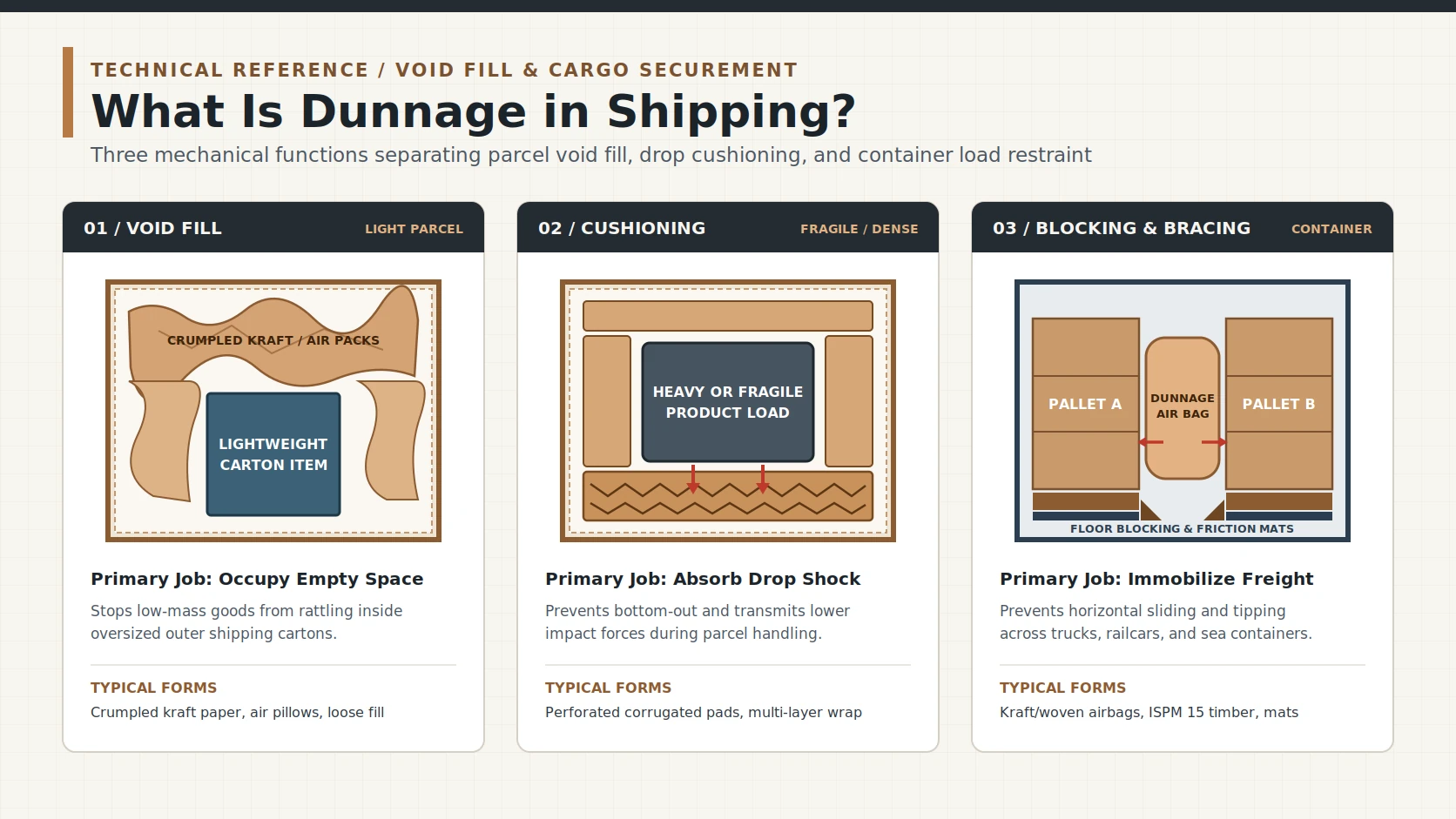
Dunnage in shipping is the loose protective, void-filling, cushioning, or load-stabilizing material placed inside cartons, trailers, and freight containers to support cargo and prevent movement or impact damage in transit. Warehouses select among paper, corrugated board, plastic film, inflatable airbags, and timber by matching material strength to cargo density and directional shipping forces.
Most parcel damage linked to dunnage packaging happens when operators treat light space-filling material as load-bearing cushioning. Placing loose crumpled light paper beneath heavy metal hardware lets transit vibration flatten the fill, opening internal slack space that leads to shifting and wall impact. Aligning packout materials with workstation dispensing is part of our void-fill machinery collection, while formal pack qualification belongs in our cardboard cushioning packaging guide.
How Does Dunnage Differ From Void Fill and Bracing?
Federal motor carrier cargo securement definitions separate general dunnage from specialized load-restraint devices by mechanical job. Dunnage means all loose materials used to support and protect cargo, whereas void fillers occupy gaps with enough strength to stop movement, blocking prevents horizontal sliding, and bracing stops cargo from tipping.
Treating those four terms as interchangeable creates specification errors on both parcel benches and container loading docks. Inside a parcel carton, a material that merely fills empty headroom does not necessarily absorb drop energy or isolate heavy edges from carton corners. Inside a truck trailer or intermodal container, federal securement definitions also distinguish inflatable dunnage bags, transverse shoring bars, and high-friction mats so engineers specify each restraint against the force direction it actually resists.
| Securement Term | Mechanical Function | Typical Placement | Regulatory Definition Basis |
|---|---|---|---|
| Dunnage | Supports and protects cargo using loose materials | Inside cartons, beneath loads, or between stowed freight units | All loose materials used to support and protect cargo |
| Void filler | Prevents cargo movement across empty gaps with load-bearing strength | Between cargo articles and the vehicle structure | Material filling space between cargo and vehicle structure with sufficient strength to prevent movement |
| Blocking | Stops horizontal sliding across the floor or carton base | Directly against or around cargo bases and sides | Structure, device, or substantial article placed against or around cargo to prevent horizontal movement |
| Bracing | Stops cargo from tipping and may also prevent shifting | Against upright faces or upper load edges | Structure, device, or substantial article placed against cargo to prevent tipping and potentially shifting |
| Dunnage bag | Fills empty voids under air pressure to lock adjacent loads | Between cargo units or between cargo and vehicle walls | Inflatable bag intended to fill empty space between cargo articles or between cargo and the vehicle wall |
| Friction mat | Raises sliding resistance beyond natural surface contact | Between vehicle deck and cargo or between stacked tiers | Device placed between deck and cargo or between cargo articles to provide greater friction than natural contact |
What Forms Does Shipping Dunnage Take Inside Parcels and Containers?
Shipping dunnage takes three physical forms depending on where the shipment sits in the supply chain: loose protective fills inside individual cartons, inflatable airbags and structural bulkheads inside trailers and sea containers, and dedicated returnable bins or trays inside manufacturing plants. Each environment imposes different compression loads, moisture exposure, and disposal rules.
In e-commerce and manufactured-goods parcel fulfillment, dunnage reference guidance describes dunnage as the protective fill packed inside a carton, box, or container to prevent merchandise damage during shipment. Parcel packing materials include wadded, crumpled, or shredded paper, expanded perforated corrugated mats, bubble wrap, styrofoam, and inflated air packs.
Inside freight containers, railcars, and highway trailers, dunnage shifts from light carton fill to structural load-immobilizing assemblies. Shippers install inflatable kraft or woven polypropylene dunnage bags across pallet gaps, nail timber chocks and bulkheads to container floors, and lay rubber friction mats beneath dense pallets. Meanwhile, manufacturing plants also use the term dunnage to describe custom-fit wood boxes, steel bins, wire baskets, and plastic trays built to hold finished parts during internal handling and returnable loops.
What Are the Main Types of Dunnage Used in Shipping?
The main types of shipping dunnage are kraft paper and shredded or perforated corrugated fiberboard for parcel void fill and cushioning, plastic bubble wrap and air pillows for lightweight or static-sensitive goods, kraft or woven polypropylene inflatable bags for container voids, and treated timber for heavy industrial freight blocking.
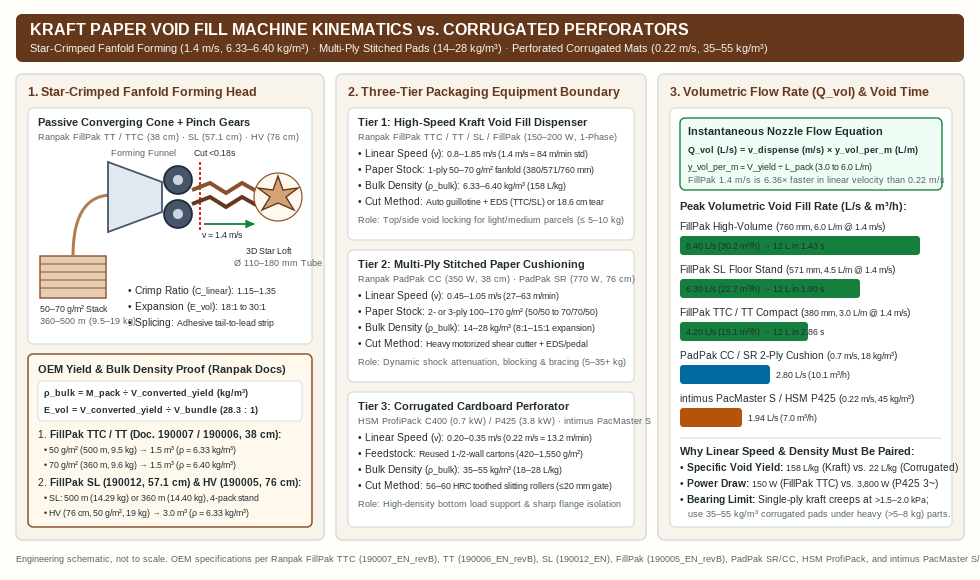
Selecting the right paper dunnage or polymer format starts with separating light void filling from dense impact cushioning and rigid container restraint. When converting fanfold kraft rolls at packing benches, paper grammage and slit width govern cushion loft and operator cycle time, as detailed in our void-fill paper basis weight and cut width reference and paper void fill machine dispensing speed and ergonomics guide.
Parcel Cushioning and Void Fill Formats
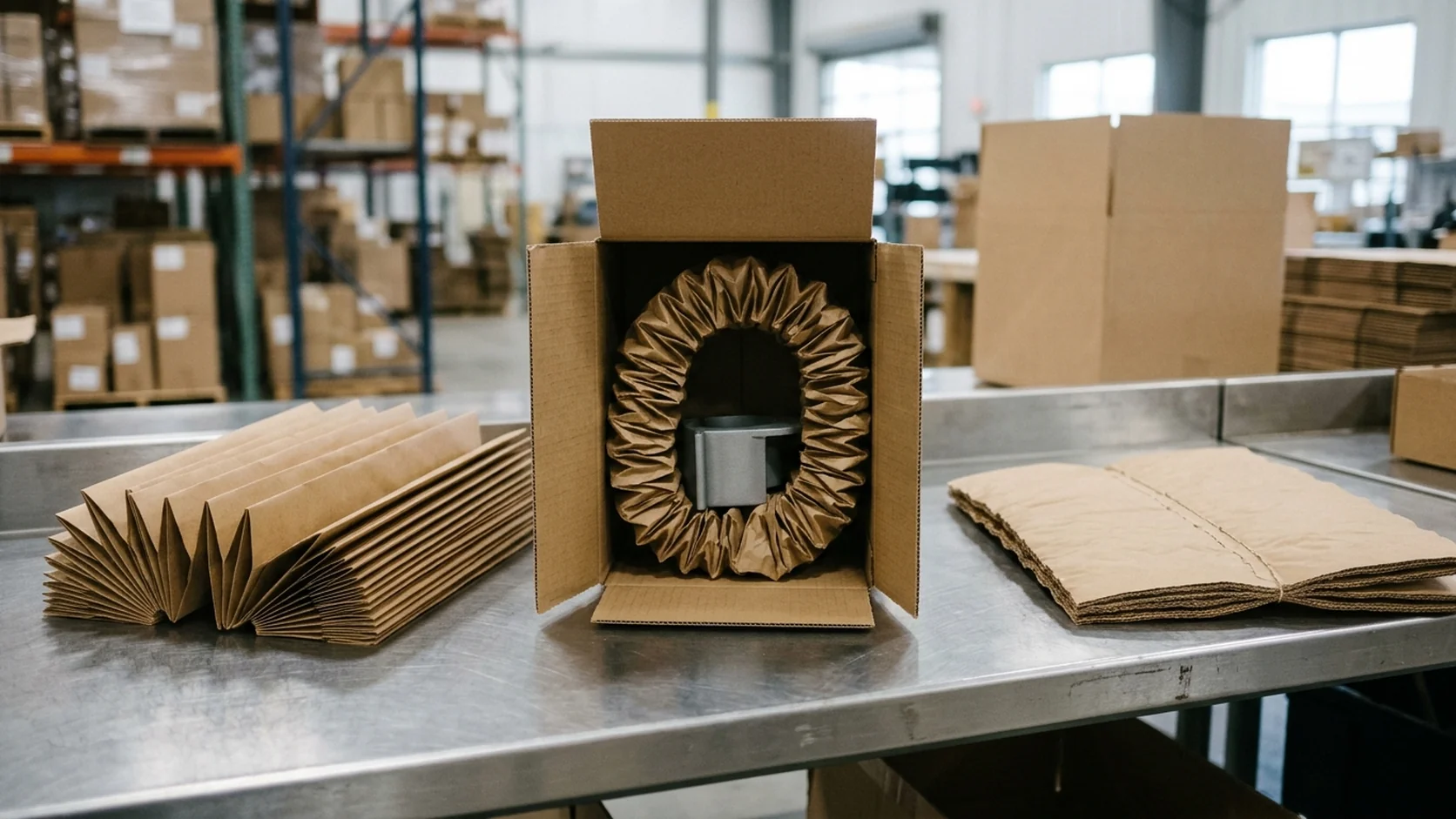
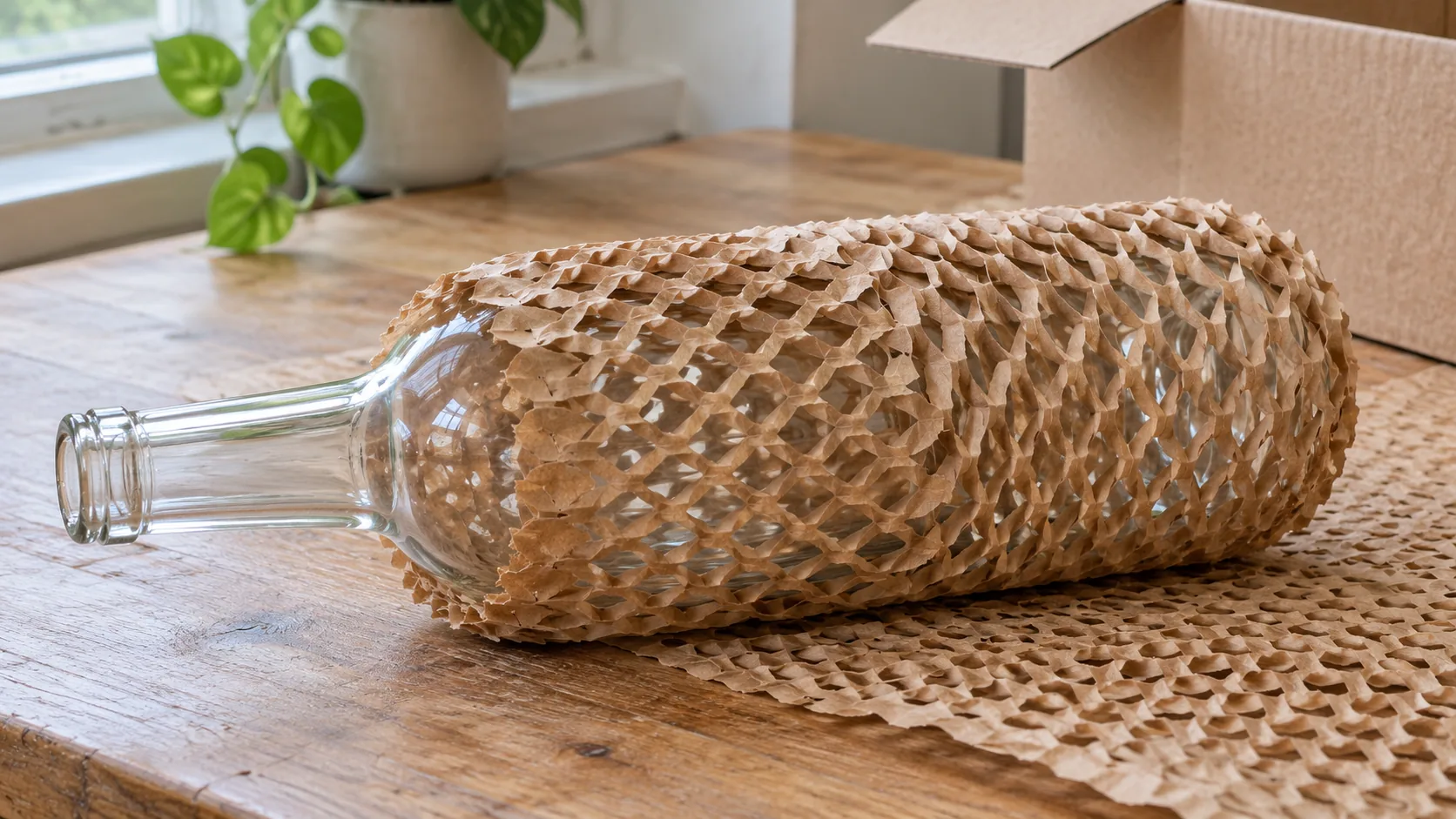
Crumpled kraft paper void fill occupies irregular headroom around lightweight cartons and folds quickly around non-fragile products. For heavier hardware or fragile items that compress loose paper wads, perforated corrugated cardboard pads and stretched kraft honeycomb paper add structured thickness. Plastic bubble wrap relies on air-filled hemispheres ranging from 6 millimetres (0.24 inches) to 26 millimetres (1.0 inch) or more in diameter, with 1 centimeter being the most common size according to bubble wrap technical documentation.
Freight Container Airbags and Treated Timber
Introduced around 1970, inflatable dunnage bags stabilize freight across ISO sea containers, closed railcars, trucks, and oceangoing vessels. Paper dunnage bags combine a polyethylene inner bladder with a lightweight high-tensile kraft paper outer shell. Woven polypropylene bags serve dry or wet conditions and extreme heavy loads because woven fabric delivers greater elasticity for wider pallet contact, higher tear strength, and stronger moisture resistance than paper bags.
Solid wood blocking and cribbing remain standard for dense machinery and unpalletized industrial loads, but cross-border ocean transport adds strict quarantine rules. Under the International Plant Protection Convention standard ISPM 15, 134 signatory countries require wood dunnage to be heat-treated or fumigated and marked with an accredited seal. At sea, MARPOL 73/78 also prohibits ships from dumping dunnage within 25 nautical miles (46 km) of shore.
| Dunnage Material | Primary Mechanical Role | Key Strength or Spec Detail | Primary Failure Mode or Regulatory Constraint |
|---|---|---|---|
| Crumpled kraft paper | Parcel void fill and light wrapping | Conforms rapidly to irregular carton headroom | Flattens under heavy dense loads if used as base cushioning |
| Perforated corrugated pad / honeycomb paper | Parcel cushioning and surface wrapping | Recyclable fiber lattice expands into thick shock pads | Sensitive to standing moisture without outer barrier |
| Plastic bubble wrap | Surface wrap, shock isolation, static control | Hemispheres from 6 mm (0.24 in) to 26 mm (1.0 in); 1 cm common | Single layer protects surfaces only; low US plastic recycling rate |
| Kraft paper dunnage bag | Container and trailer void immobilization | Polyethylene inner air bladder with high-tensile kraft shell | Punctures against nails or sharp pallet edges; must match void |
| Woven polypropylene dunnage bag | Heavy-load and wet-condition container blocking | Higher elasticity, tear strength, and moisture resistance than paper | Fails to stabilize if bag size does not match cargo void |
| Treated wood timber | Rigid floor blocking, chocks, and bulkheads | High compressive rigidity for heavy or rolling cargo | Requires IPPC ISPM 15 treatment and seal across 134 countries |
How Is Dunnage Used to Block Cargo in a Shipping Container?
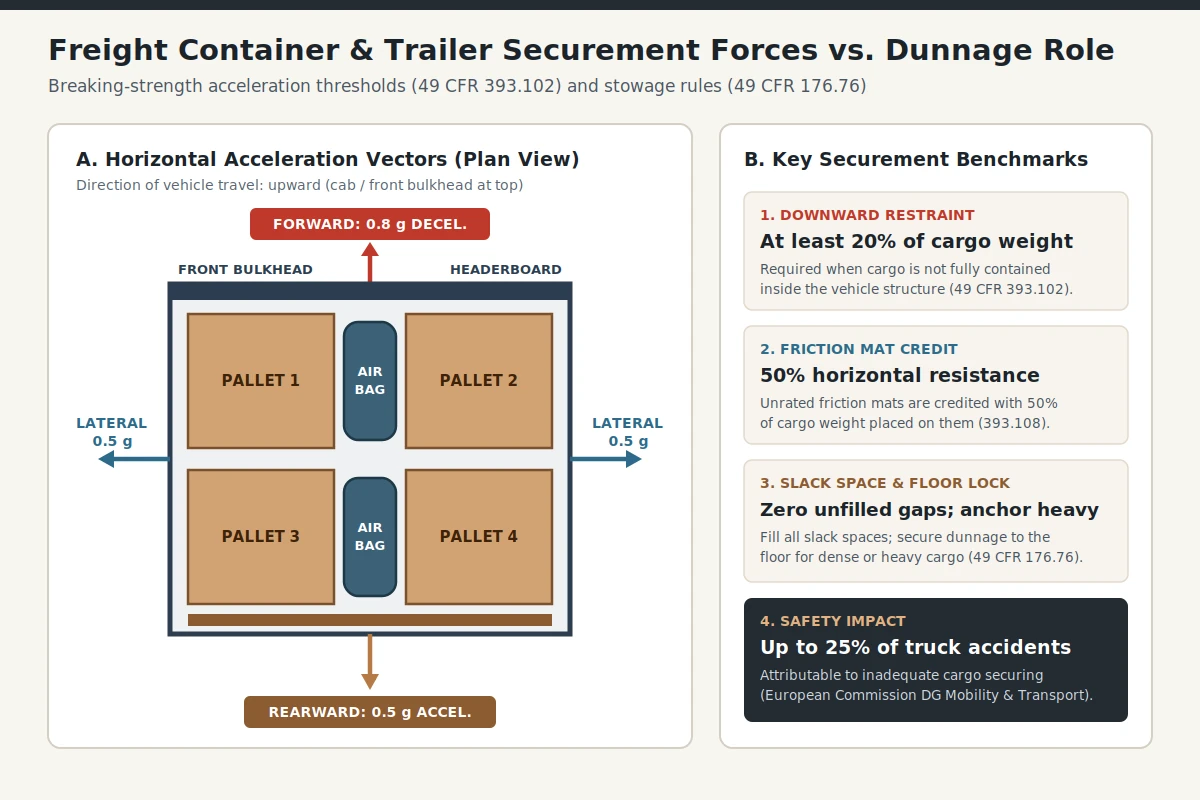
Cargo inside highway trailers and maritime containers is blocked by filling every slack space between freight units and container walls with defect-free dunnage, matched inflatable airbags, cargo-height bulkheads, and floor-anchored chocks. European Commission mobility data cited in dunnage bag safety records attribute up to 25 percent of truck accidents to inadequate cargo securing.
Federal highway cargo securement regulations mandate that cargo be firmly immobilized by adequate vehicle structures, dunnage or dunnage bags, shoring bars, tiedowns, or a combination of those controls. Every piece of dunnage, chock, cradle, shoring bar, blocking, or bracing must be free of damage or defects that compromise securement performance. Breaking-strength performance criteria require restraint systems to withstand 0.8 g deceleration in the forward direction, 0.5 g acceleration in the rearward direction, and 0.5 g acceleration in a lateral direction, plus a downward force of at least 20 percent of cargo weight when loads are not fully contained inside the vehicle structure.
Container Stowage Rules for Slack Spaces and Heavy Cargo
Under federal vessel freight container stowage rules, all packages inside a transport vehicle or freight container must be secured against shifting in any direction. Shippers must fill any slack spaces between packages with dunnage and install dunnage bulkheads extending to the level of the cargo unless packages sit flush against the sides or ends. When cargo consists of dense materials or heavy packages, dunnage must be secured directly to the container floor, and total container weight must be distributed as evenly as possible without exceeding the maximum permissible weight.
Rolling Cargo, Friction Mats, and Airbag Sizing Limits
Rolling items such as coils, drums, or cylinders require chocks, wedges, cradles, or equivalent restraints that cannot loosen in transit. Where shippers lay friction mats under pallets without a manufacturer load rating, federal highway securement rules credit unrated friction mats with horizontal movement resistance equal to 50 percent of the cargo weight resting on the mat. When deploying inflatable dunnage bags across lateral voids, operators must match bag dimensions strictly to the gap—mismatched bags fail to lock the load and create cargo and personnel hazards—and shield bags from pointed nails or splintered pallet edges that cause rapid deflation.
When Does Paper or Shredded Board Replace Plastic Bubble Dunnage?
Paper and converted corrugated dunnage replace plastic bubble wrap cleanly in dry parcel shipping for void filling, abrasion protection, and structured drop cushioning, while plastic bubble wrap retains specific technical roles for static-sensitive electronics and sealed moisture barriers. End-of-life recovery rates show the widest divergence between fiber and plastic packaging streams.
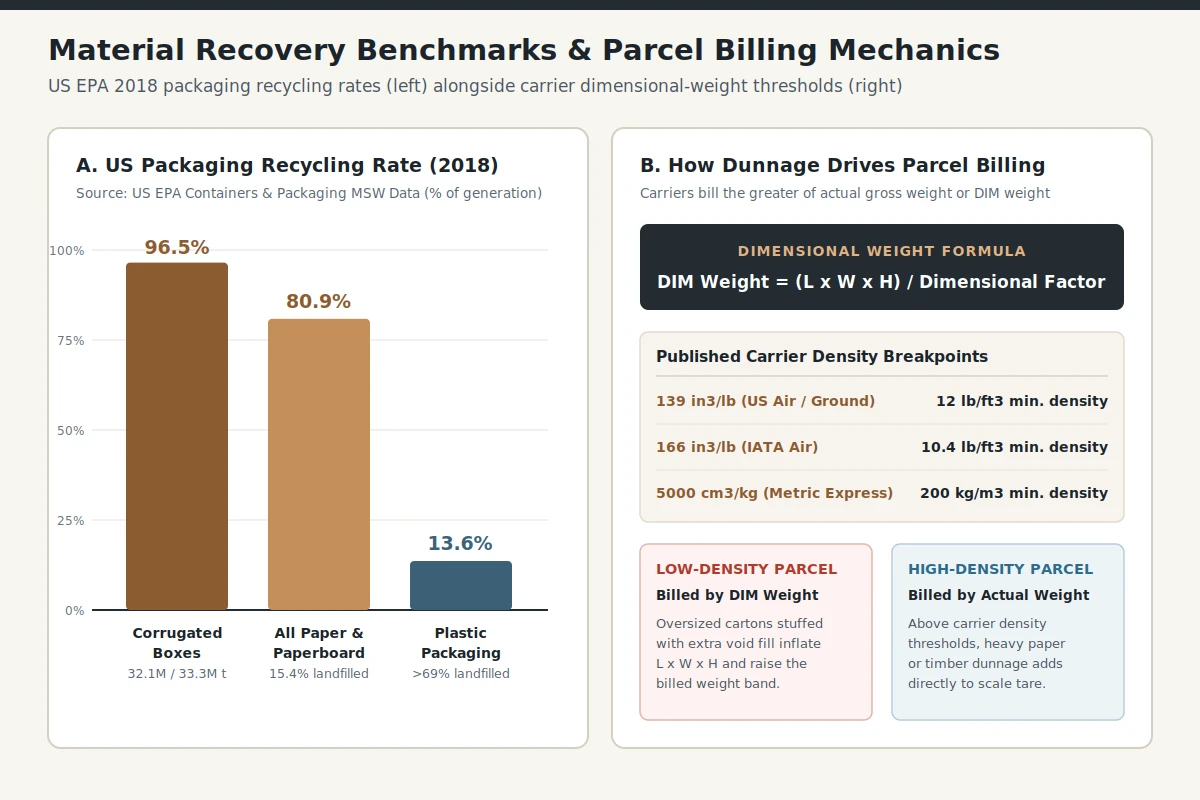
According to U.S. EPA containers and packaging data for 2018 municipal solid waste (MSW), corrugated boxes were the single largest MSW product category at 33.3 million tons generated (11.4 percent of total MSW), with 32.1 million tons recycled out of 33.9 million tons of total paper and paperboard recycling—a 96.5 percent recycling rate. Across all paper and paperboard packaging combined, the overall recycling rate reached 80.9 percent, with 3.7 percent combusted for energy recovery and 15.4 percent landfilled. By contrast, plastic containers and packaging recorded a 13.6 percent recycling rate (almost 2 million tons recycled), with 16.9 percent combusted for energy recovery and over 69 percent landfilled.
In packout engineering, matching the protection mechanism matters as much as recyclability. A single layer of plastic bubble wrap provides surface protection, whereas multiple layers may be needed to provide shock and vibration isolation. For dry goods, recyclable paper alternatives—including heavily embossed thick paper wrap and die-cut stretched kraft honeycomb paper whose parting lines expand into a cushioning structure—replace multi-layer polymer wrap without introducing mixed-resin film into curbside recycling. Compare structural tradeoffs across fiber wrap and converted board pads in our honeycomb paper wrap versus shredded cardboard cushioning comparison. Keep antistatic bubble wrap where sensitive electronic parts and chips require static-charge dissipation during transit.
How Does Dunnage Weight Affect Parcel and Freight Billing?
Dunnage affects shipping charges through two competing billing mechanisms: oversized cartons packed with excess void fill trigger higher dimensional (DIM) weight charges on low-density parcels, whereas heavy fiber pads or timber blocking add directly to actual gross weight on high-density parcels and weight-limited freight containers.
Under commercial parcel dimensional weight rules, the shipping fee is billed on dimensional weight or actual weight, whichever is greater. Dimensional weight—also called DIM weight, volumetric weight, or cubed weight—equals length times width times height divided by the carrier dimensional factor. Starting in 2015, both UPS and FedEx applied the greater of actual weight or dimensional weight across all air and ground shipments rather than limiting DIM billing to oversized bands.
Carrier Density Breakpoints and Carton Right-Sizing
Each carrier dimensional factor defines a minimum billed density threshold below which the carrier bills box volume instead of scale weight. A divisor of 139 cubic inches per pound equals a minimum density of 12 pounds per cubic foot; a divisor of 166 cubic inches per pound—common for IATA air shipments—equals 10.4 pounds per cubic foot; and a metric divisor of 5000 cubic centimeters per kilogram equals 200 kilograms per cubic meter.
| Billing Regime | Carrier Density Threshold | How Excess Dunnage Impacts Freight Billing | Operational Control |
|---|---|---|---|
| US domestic / express DIM (139 in3/lb) | Below 12 lb/ft3 | Oversized outer carton stuffed with extra void fill inflates L x W x H and raises billed DIM weight | Right-size cartons first to minimize empty void volume before selecting fill |
| IATA air DIM (166 in3/lb) | Below 10.4 lb/ft3 | Extra carton headroom increases volumetric charge even when air pillows weigh almost nothing | Reduce outer box height and fold compact protective liners |
| Metric express DIM (5000 cm3/kg) | Below 200 kg/m3 | Air-filled dead space in oversized boxes is billed as if cargo weighed 200 kg/m3 | Standardize tight box footprints across core SKU dimensions |
| High-density parcel or full container | Above carrier DIM threshold or near max container weight | Heavy paper pads, corrugated stacks, or timber blocking add directly to scale weight and container payload | Place dense cushioning only on load-bearing faces and distribute container weight evenly |
Because carriers charge whichever figure is higher, switching from heavy kraft pads to lightweight air pillows will not lower parcel billing if the carton stays oversized and remains governed by DIM weight. Conversely, on dense hardware shipments that exceed 12 pounds per cubic foot (200 kilograms per cubic meter) or approach container maximum permissible weight limits, minimizing dead tare by concentrating structured corrugated pads only on vulnerable load-bearing faces keeps both actual gross weight and product damage under control.