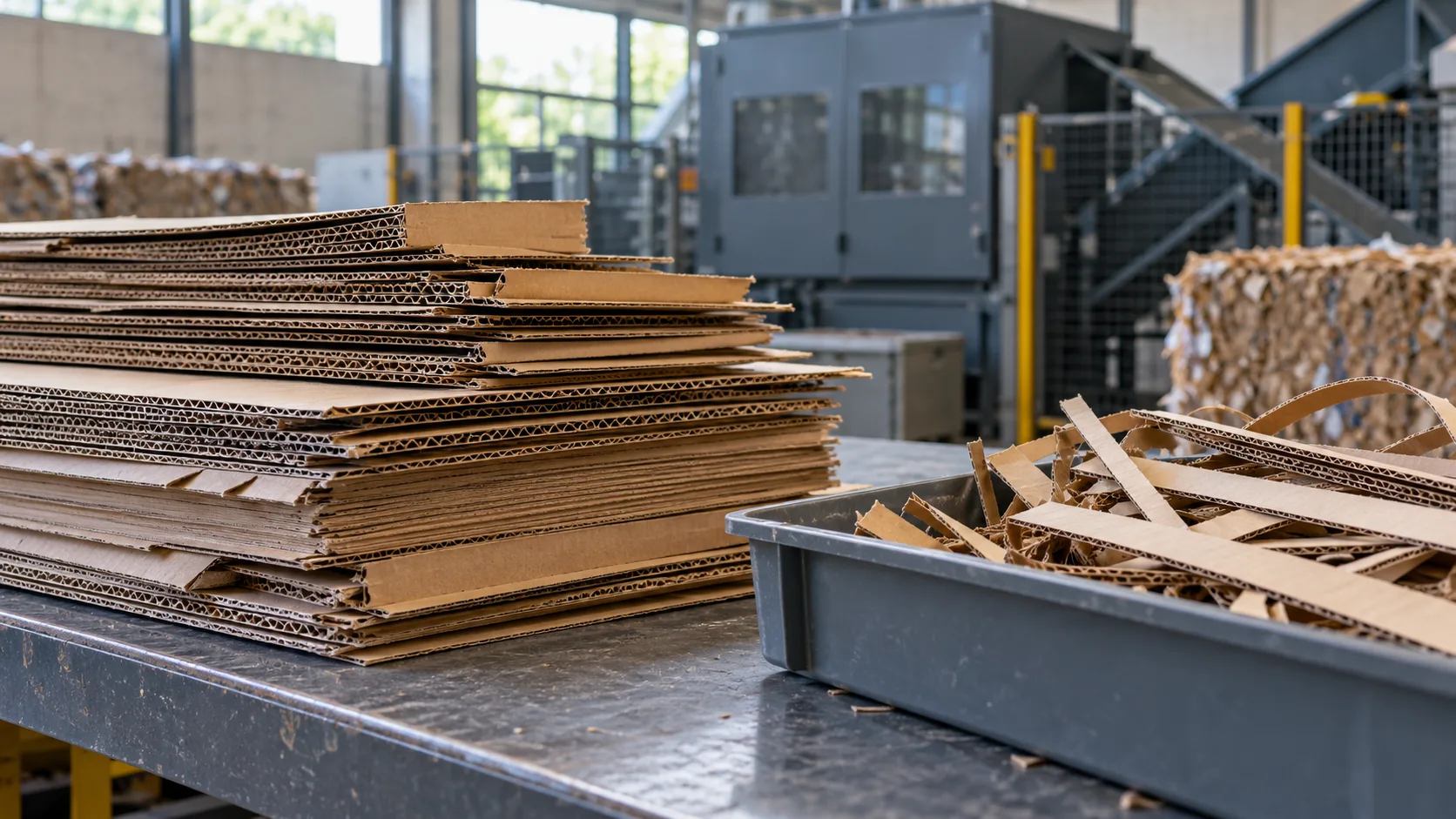
Estimating the usable pad yield of a cardboard perforator directly from the unfolded area of a salvaged shipping carton overstates finished cushioning output when limit-stop / automatic width cut-off trimming, folded-flap thickness limits, and compression-plate startup pieces are omitted from the station calculation. Before sizing a corrugated conversion bench within our cardboard shredders collection, record the documented perforation grid dimension, the working-width limit stop, the permitted layer and height gates, and the measured expansion factors on the incoming board grade.
Size single-carton pad yield around documented machine boundaries and measured sample strips. Record the cutter grid dimension, verify whether the blank clears both the intake height gate and the layer limit without pre-slitting, deduct any side-trim offcut strip narrower than your usable pad specification, and validate the finished packout under transport simulation tests.
Read the perforation grid dimension and output format
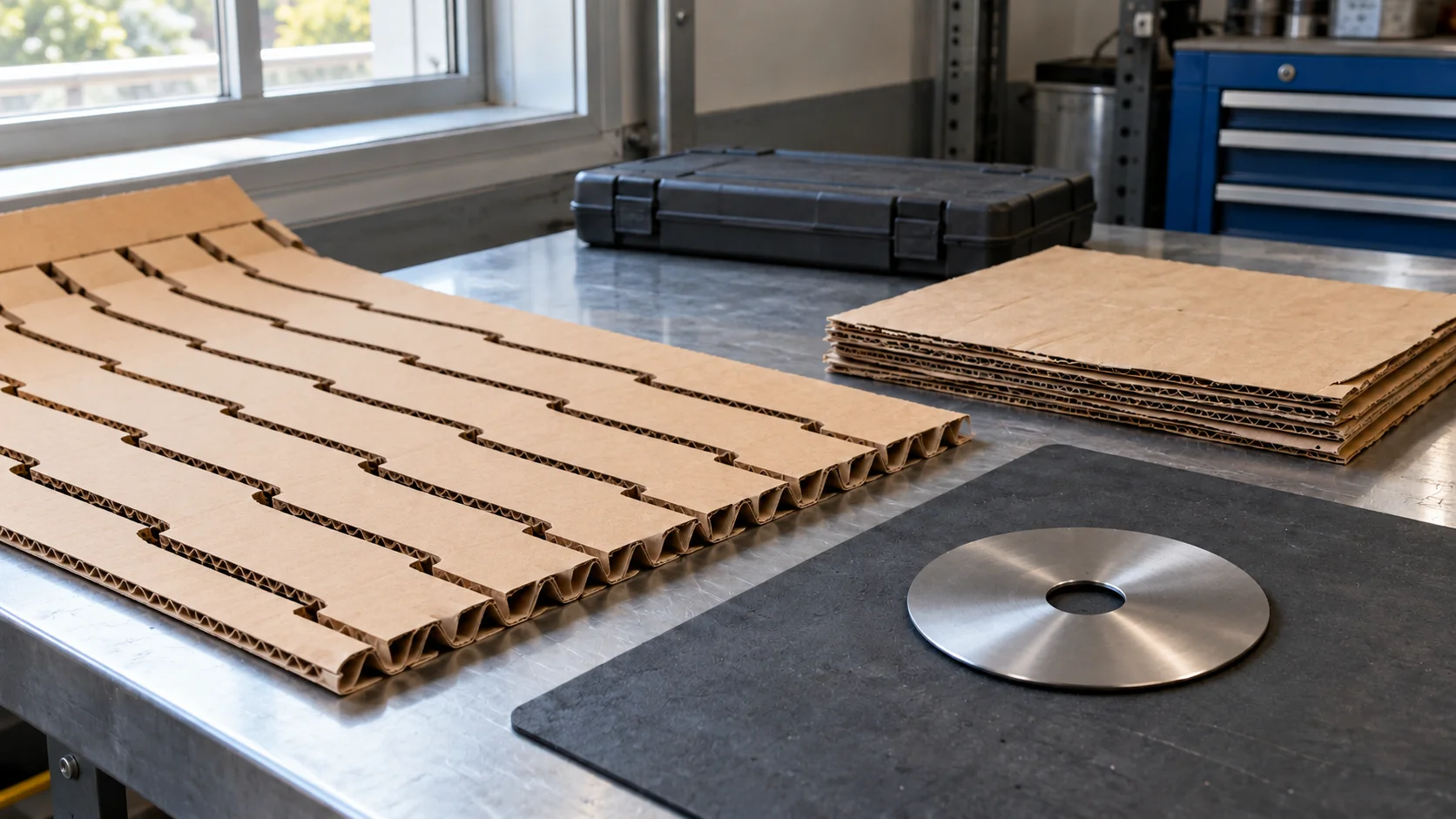
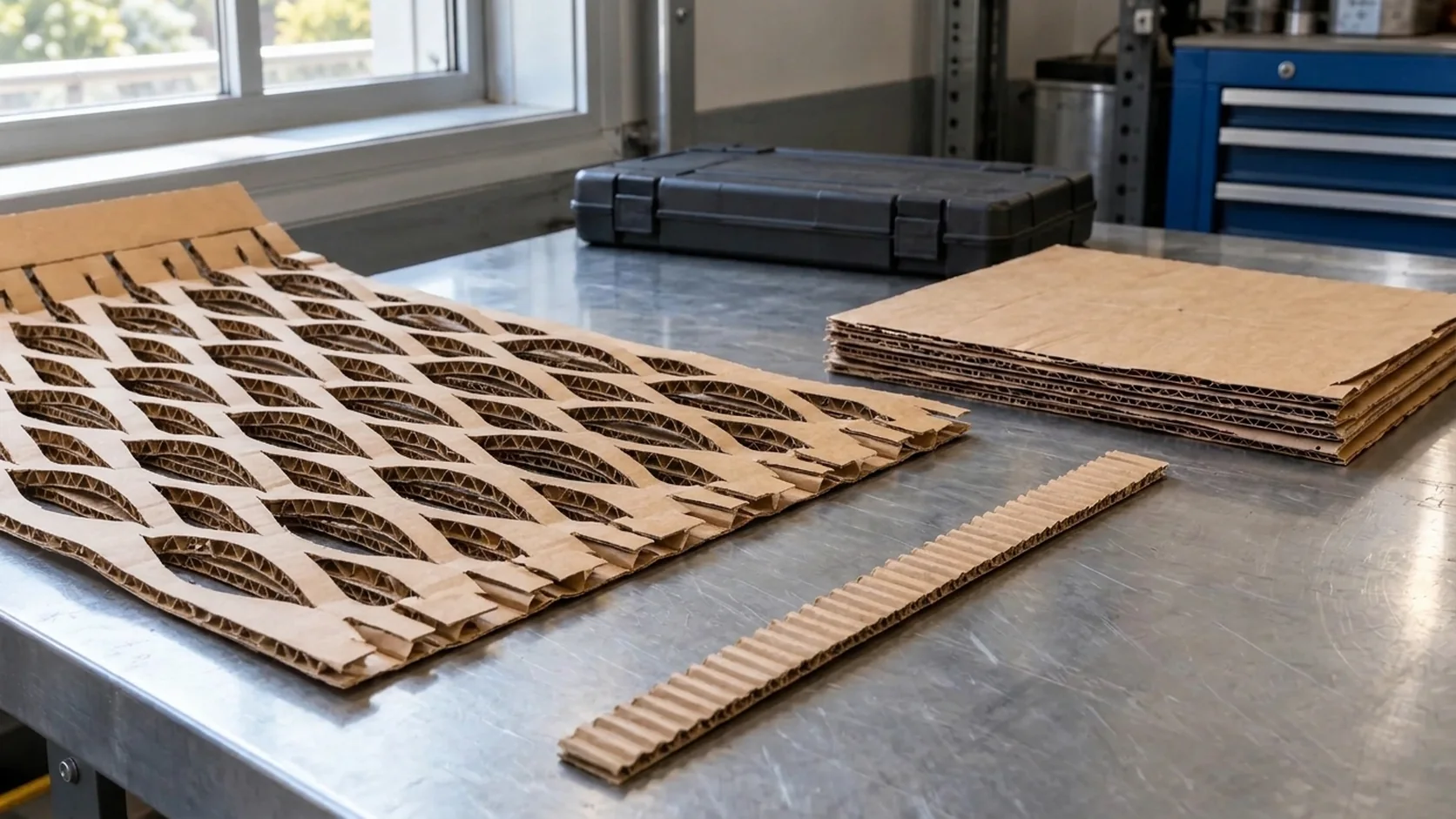
A cardboard perforator slits corrugated board into an expandable lattice rather than severing the sheet into disconnected strips, unless a dedicated chip-cutting unit is selected. For workstation selection between connected lattice mats and loose fill, compare the output mechanics in our cardboard shredder vs perforator guide.
With the HSM ProfiPack C400 cardboard perforator, used cardboard is transformed into packaging material in one work step as a mobile and flexible tabletop device. The HSM ProfiPack range covers compressed cushioning mats for maximum flexibility when filling, flat cushioning mats for flat cushioning and protection of sensitive surfaces, and cardboard chips for filling small cavities.
In the HSM ProfiPack P425 operating instructions, grid dimension is 5 x 100 mm. On the intimus PacMaster S and intimus PacMaster VS data sheet, cutting size (mm x mm) is 4 x 110 for both PacMaster models. In the intimus PacMaster S operating manual technical data, cutting width is 4x110 mm and cutting capacity is 2 layers cor. board quality 3.1 (maximum thickness of cor. boards 18 mm).
By contrast, HSM ProfiPack ecoChip has product number 1531854 (1531954 incl. adapter set for dust extraction), cutting capacity up to 3 layers (maximum 20 mm height), and throughput up to 100 kg/h. For the HSM ProfiPack ecoChip, cutting result is 10.5 x 40-55 mm or 10.5 x 40-200 mm, depending on the cardboard feed direction. On the HSM ProfiPack ecoChip technical data sheet, if the carton is fed in with the shaft, the cutting result is 10.5 x 40-55 mm; if the box is fed against the shaft, the result is 10.5 x 40-200 mm.
Die-cut kraft paper converters use a different web geometry and feedstock specification. On the Ranpak Geami WrapPak HV specification folder, Die Cut Paper has base weight 80 gr/m², roll length 250 m, and paper width 50.8 cm (20 in.), while Interleaf Paper has base weight 22 gr/m², roll length 840 m, and paper width 30.5 cm (12 in.). The Geami WrapPak HV converter expands the die cut paper to a 3D honeycomb structure providing a wrapping product without tape.
| Machine or material configuration | Published cut or roll specification | Documented output role |
|---|---|---|
| HSM ProfiPack P425 operating manual | Grid dimension is 5 x 100 mm | Manufacture of packaging padding made from cardboard |
| intimus PacMaster S and intimus PacMaster VS data sheet | Cutting size (mm x mm) is 4 x 110 | Accurate cutting of cardboard into padding mats |
| HSM ProfiPack ecoChip technical data sheet | Cutting result is 10.5 x 40-55 mm with the shaft or 10.5 x 40-200 mm against the shaft | Cardboard chips for filling small cavities |
| Ranpak Geami WrapPak HV specification folder | Die Cut Paper 80 gr/m², 250 m roll length, 50.8 cm (20 in.) paper width; Interleaf Paper 22 gr/m², 840 m roll length, 30.5 cm (12 in.) paper width | Die cut paper and interleaf paper roll specifications for honeycomb wrapping |
Separate flat perforating mode from compression-plate padding mode
On the HSM ProfiPack C400 technical data sheet, depending on the application, the cushioning volume of the packaging material can be adjusted as required. Creation of compressed packaging material is performed with a closed compression flap on the HSM ProfiPack C400 and P425.
In the HSM ProfiPack P425 operating instructions, for perforating cardboard, push lever (1) downwards and feed in the cardboard. In the HSM ProfiPack P425 operating instructions, for padding cardboard, release locking bolt (1), pull lever (2) upwards, and insert at least 2-3 pieces of cardboard one after the other so the padded cardboard comes out on the compression plate.
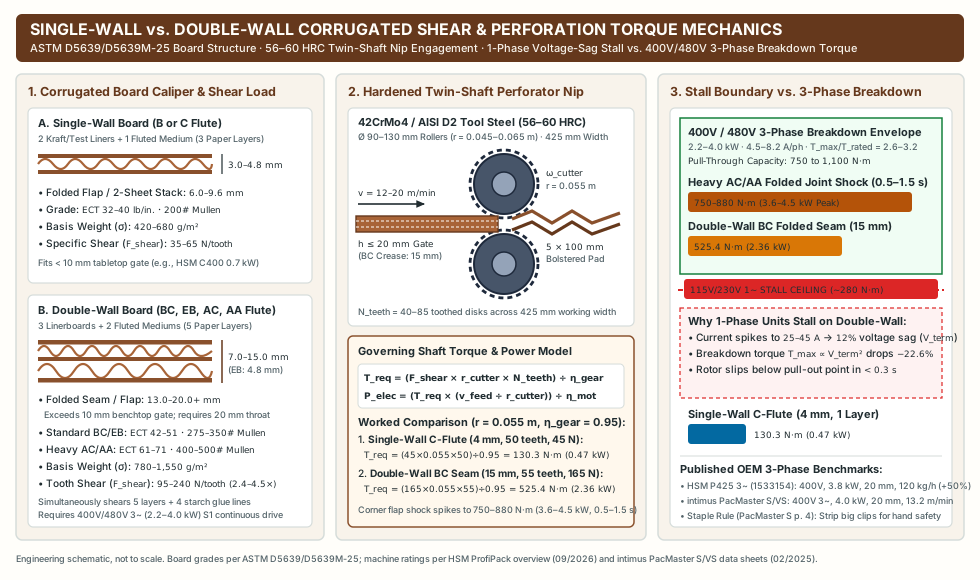
Mode transitions and thickness overloads on the HSM ProfiPack P425 require explicit operator steps. In the HSM ProfiPack P425 operating instructions, remove material residue when changing from “Padding cardboard” to “Perforating cardboard” by switching off the machine and removing residual material on the pressing plate by hand. In the HSM ProfiPack P425 operating instructions, if cardboard is too thick, press the “Reverse” button so the cutting unit runs in reverse; if overloaded, switch the machine off and allow the Profipack to cool for 20-30 minutes before restarting.
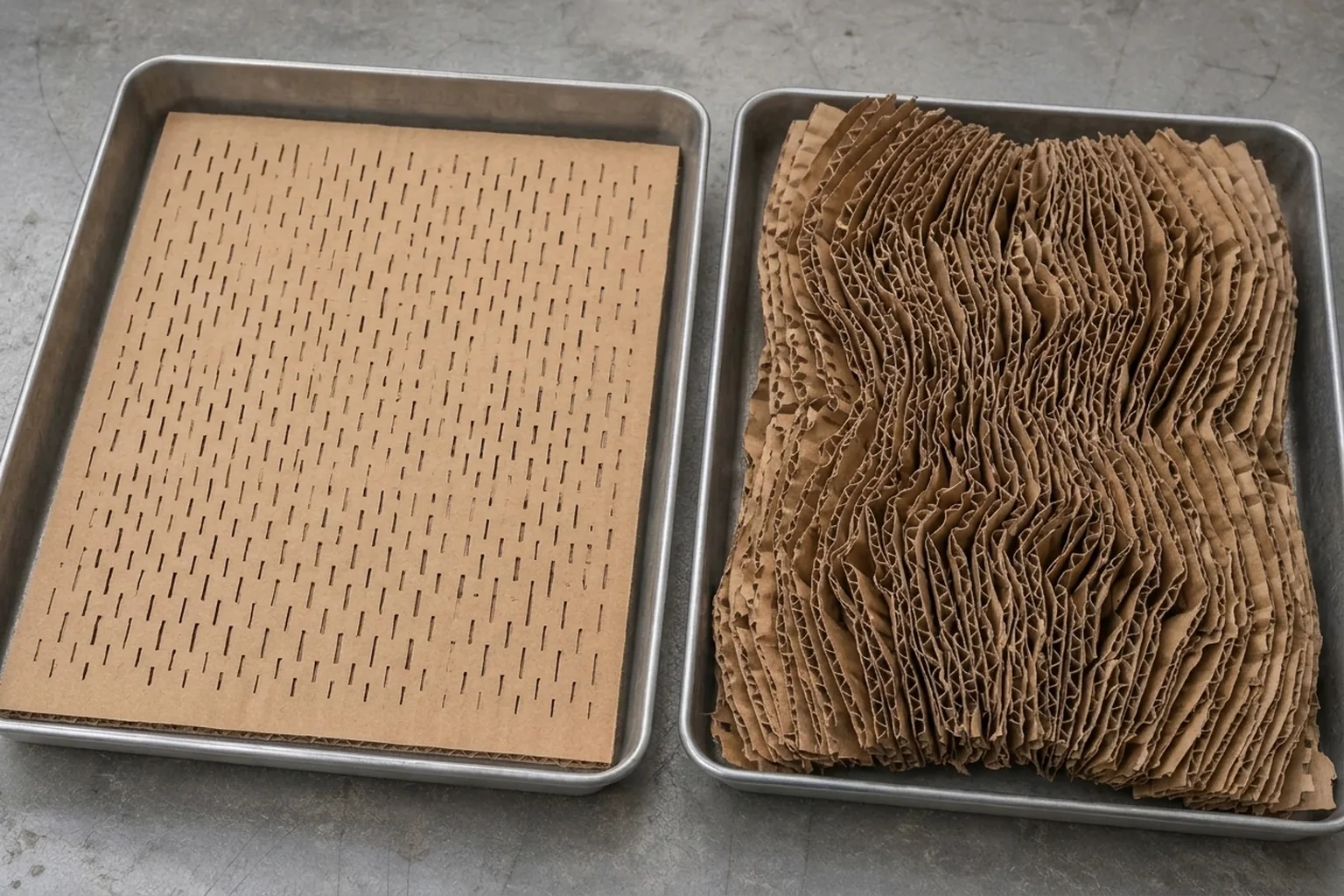
Account for working width, side-blade trimming, and intake gates
When a flattened carton blank exceeds the set pad width, the limit stop / automatic cut-off severs the excess width during the pass. On the HSM ProfiPack C400 technical data sheet, the infinitely variable adjustment of the working width with a scale allows the production of cushioning material exactly as required. In the HSM ProfiPack P425 operating instructions, cardboard is processed up to a width of 425 mm; the required width is set using the limit stop, and cardboard that is wider is cut off automatically. In the HSM ProfiPack P425 operating instructions, place the cardboard against the limit stop on the right and push it into the infeed opening until the cutting unit grips the cardboard, then let go immediately.
On the intimus PacMaster S / VS data sheet, a size guide on the work surface ensures accurate cutting of the cardboard and adjusts the size of the padding mats to the required size. In the intimus PacMaster S operating manual, the board is cut into a packaging pad of up to approx. 425 mm in width depending on the working width of the cutting system, and overlong strips are automatically cut off. In the intimus PacMaster S operating manual, the tape measure (4) attached to the inlet guide serves as a guide for the required width of the packaging pads (fig. 3).
The Greenwave 432 Cardboard Perforator uses heavy-duty solid steel blades to transform corrugated shipping cartons into perforated packing materials. On the Formax Greenwave specification sheet feature callouts, set the side guide to trim cardboard to custom size, and cardboard up to .4 in. thick is transformed into net-like cushioning packing material. On the Formax Greenwave specifications table, Perforating Speed is up to 40 fpm (12.2 m), Maximum Perforating Width is up to 16.9 in. (430 mm), and Maximum Input Thickness is up to .79 in. (20 mm). On the Formax Greenwave specifications table, Dimensions W x D x H are 24.8 x 22.4 x 38.1 in. (63 x 57 x 97 cm), Waste Bin Capacity is up to 28 gal (106 l), Weight is 271 lbs (123 kg), Motor is 1 HP, and Power Supply is 115V 60Hz.
Incoming carton blanks must also satisfy the intake height gate and layer limit of the specific machine configuration. In the HSM ProfiPack overview table, product numbers are 1528134 (C400), 1531154 (P425 AC), and 1533154 (P425 three-phase), and product numbers incl. adapter set for dust extraction are 1531054 and 1533054. In the HSM ProfiPack overview table, cutting capacity in layers is 1 (maximum 10 mm height) for C400 and up to 3 (maximum 20 mm height) for both P425 models. In the HSM ProfiPack overview table, throughput in kg/h is up to 50, up to 80, and up to 120 across the three columns of the C400 and P425 overview table. In the HSM ProfiPack overview table, power consumption in kW is 0.7 (at 230 V / 50 Hz), 2.0 (at 220-240 V / 50/60 Hz), and 3.8 (at 400 V / 50 Hz) across the three columns of the C400 and P425 overview table.
Individual model datasheets and operating manuals record the exact electrical, dimensional, and acoustic boundaries for each configuration:
- On the HSM ProfiPack C400 technical data sheet, intake width is 415 mm and voltage / frequency is 220-240 V / 50 Hz.
- On the HSM ProfiPack C400 technical data sheet, infeed height is 10 mm and power consumption is 625 W.
- On the HSM ProfiPack C400 technical data sheet, throughput capacity is 50 kg/h and noise level in idle operation is ca. 68 - 70 dB(A).
- On the HSM ProfiPack C400 technical data sheet, dimensions (Width x Depth x Height) are 610 x 395 x 375 mm and machine weight is 46.65 kg.
- On the HSM ProfiPack P425 AC technical data sheet, order number 1531154 (EAN 4026631062596) has throughput capacity 80 kg/h, idle noise level ca. 60 - 62 dB(A), voltage/frequency 220-240 V / 50-60 Hz, and intake width 425 mm.
- On the HSM ProfiPack P425 AC technical data sheet, infeed height is 20 mm, power consumption is 2000 W, dimensions (Width x Depth x Height) are 770 x 611 x 1040 mm, and machine weight is 160 kg.
- On the HSM ProfiPack P425 three-phase technical data sheet, order number 1533154 (EAN 4026631072731) has throughput capacity 120 kg/h, idle noise level ca. 63 - 64 dB(A), voltage/frequency 400 V / 50 Hz, and intake width 425 mm.
- On the HSM ProfiPack P425 three-phase technical data sheet, infeed height is 20 mm, power consumption is 3800 W, dimensions (Width x Depth x Height) are 770 x 611 x 1040 mm, and machine weight is 181 kg.
- In the HSM ProfiPack P425 operating instructions, cutting capacity is up to 3 layers of cardboard, operating speed is 12.1 m/min, working width is 425 mm, and infeed height is 20 mm.
- On the intimus PacMaster S / VS data sheet, intake width x height (mm) is 425 x 15 and cutting capacity in layers is 3 for both intimus PacMaster S and intimus PacMaster VS.
- On the intimus PacMaster S / VS data sheet, intimus PacMaster S has a speed of 240 mm/s, while intimus PacMaster VS uses Vario-Speed (VS) so the shredder can be operated from a 230 V power socket.
- On the intimus PacMaster S / VS data sheet, cutting speed (mm/s) is 240 (PacMaster S) and 90 - 290 (PacMaster VS); motor power consumption (W) is 2.600; product dimensions W x D x H are 69 x 47 x 95 cm; and product weight is 176 kg and 185 kg.
- On the intimus PacMaster S / VS data sheet, throughput is up to 7 m³/h for intimus PacMaster S and up to 11 m³/h for intimus PacMaster VS, depending on feeding type and paper quality.
- In the intimus PacMaster S operating manual technical data, inlet guide cutting system is 15 mm, working width cutting system is 425 mm, cutting speed is 0.18 m/sec., power consumption is 3.9 kW, and power output is 2.2 kW.
For how feed gates and linear cutting speeds interact with hourly mass output, see our cardboard shredder machine blade types and throughput guide.
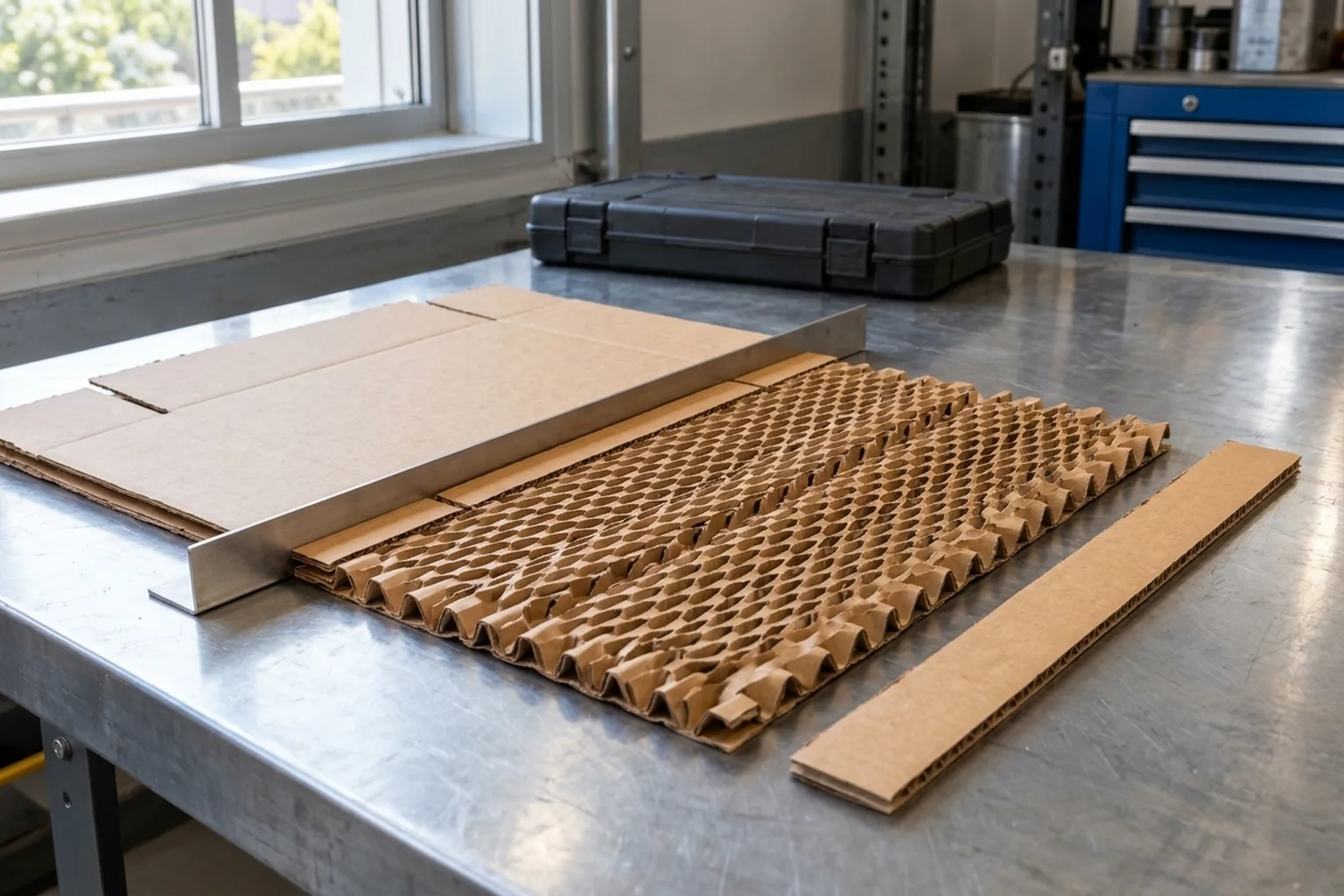
Pre-sorting and dust extraction interfaces also govern usable output and workstation safety. On the HSM ProfiPack C400 technical data sheet, the induction-hardened solid steel cutting rollers are wear-resistant against cardboard staples. In the intimus PacMaster S operating manual, due to danger of injury when later handling the packaging pads, existing metal clips and staples must be removed by means of a suitable staple remover before cutting into packaging pads. In the HSM ProfiPack P425 operating instructions, do not shred any material that tends to form loops, e.g. tapes, bindings and soft plastic film.
The HSM DE 1-8 dust extractor can be operated optionally with the HSM ProfiPack P425 and the HSM ProfiPack ecoChip (model including adaptation kit for extraction). In the intimus PacMaster S operating manual, to reduce dust development during the production of filler pads, the PacMaster S is fitted with a connector sleeve of diameter 50 mm for connecting common industrial vacuum cleaners. For vacuum port sizing and hood routing at the conversion table, see our cardboard perforator dust extraction guide.
Calculate single-box pad yield and compare against the parcel-fill benchmark
Measure the transverse width factor and longitudinal length factor directly on a calibration strip of your facility’s salvaged board before projecting shift output.
Define the dimensional relationships for a single flattened carton blank:
- Full-width pass count: Divide the incoming blank width by the target pad width setting on the limit stop and take the whole number of full-width strips.
- Side-trim offcut width: Subtract the total width of full-width strips from the incoming blank width to identify the remaining side offcut width.
- Width offcut ratio: When the remaining side offcut strip is narrower than the minimum usable pad width for the packout, divide the remaining offcut width by the incoming blank width to express the width offcut ratio.
- Expanded pad area: Multiply the usable infeed strip width by the blank length, the measured transverse width factor, and the measured longitudinal length factor.
Worked example: single-box pad area and width offcut ratio
For this example, assume a flattened carton blank with a 600 mm feed width and an 800 mm feed length. For example, assume a measured transverse width factor of 1.25 and a longitudinal length factor of 0.90 on the test strip.
In this example, feeding the 600 mm blank at a 425 mm limit stop trims off a 175 mm side strip, which represents a 29.17 % width offcut ratio if discarded. For example, the 425 mm by 800 mm primary strip has a 0.34 m² infeed area and, at factors of 1.25 and 0.90, yields 0.3825 m² of expanded pad area. If the packout specification accepts the narrower side strip as a secondary filler pad, feeding that offcut strip on a separate pass recovers the remaining board area.
Published parcel-fill benchmark
In the HSM ProfiPack overview packaging example using a 1,000 x 415 mm BC corrugated board sheet to fill a 40 x 30 x 20 cm shipping carton to 50%, one hour of output packs 480 parcels, 600 parcels, or 720 parcels. That 1,000 x 415 mm sheet equals 0.415 m² of board area, while the 40 x 30 x 20 cm carton equals 24 L of total volume and 12 L at a 50 % fill.
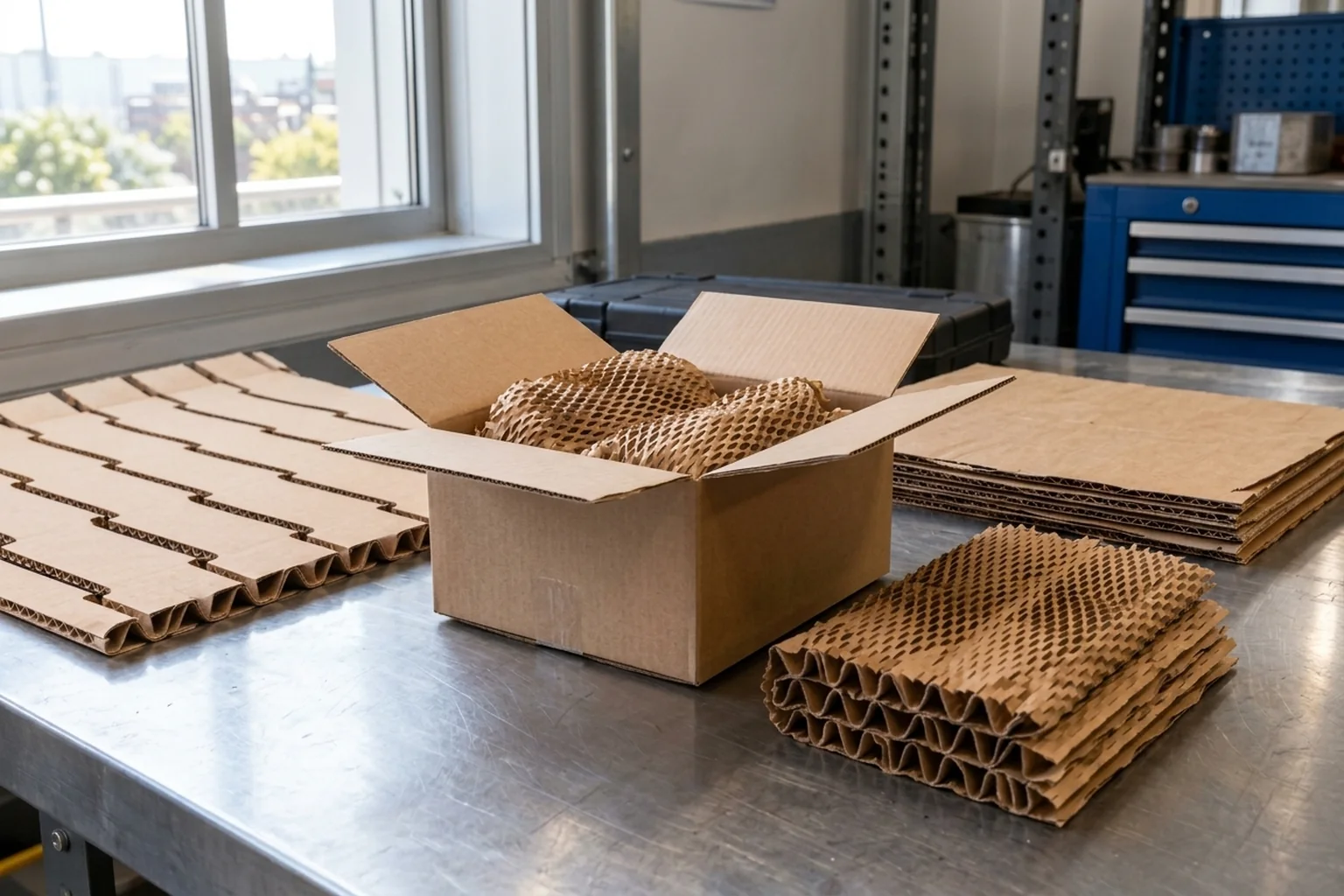
Qualify incoming board grades and verify package cushioning
Calculating expanded pad area establishes how much packing material a salvaged carton blank produces, while qualifying that pad for product protection requires checking the corrugated board structure and testing the packed shipping container. For station-level packout trials, pair these standards with our cardboard cushioning packaging guide.
ASTM D4727 covers corrugated and solid fiberboard sheet stock (container grade) and cut shapes intended for use mainly in the fabrication of boxes and interior details such as pads, sleeves, liners, partitions, and die-cut sheets. Under ASTM D4727, corrugated fiberboards shall be manufactured with two, three, or four facings for single-, double-, or triple-wall varieties, and tested for thickness, basis weight, puncture resistance, ply separation, bursting strength, and edge crush. Under ASTM D4727 §1.2, the performance of fiberboard boxes is largely dependent on the paper components from which they are fabricated and, in the case of corrugated boxes, on the flute structure as well.
ASTM D5639 describes attributes of corrugated fiberboard and boxes relating to distribution hazards and test parameters specified to ensure sufficient strength in the box for containment, storage, handling, transport, and protection of contents. Under ASTM D5639 §1.3.2, engineering principles are used to select corrugated material combinations based on material characteristics such as caliper, edge crush value, and flat crush to meet initial box compression requirements measured by Test Method D642. Under ASTM D5639 §1.3.4 and §1.3.5, boxes requiring drop and impact toughness can be tested using rough handling protocols such as Practice D4169 or ISTA 3 Series, and all proposed constructions and designs should be vetted through samples, testing, prototype packing, and shipping.
Under ASTM D1596 §5.1, dynamic cushioning test data obtained by this test method are applicable to the cushioning material and not necessarily the same as obtained in a package, and can be affected by specimen area, thickness, and loading rate. ISTA 1 Series Non-Simulation Integrity Performance Tests challenge the strength and robustness of the product and package combination as screening tests, including Procedure 1A (150 lb / 68 kg or less) and Procedure 1B (over 150 lb / 68 kg). ISTA 3-Series General Simulation Tests (3A, 3B, 3E, 3F, 3H, 3K, 3L, 3N, 3M, 3P) provide a simulation of the damage-producing motions, forces, conditions, and sequences of transport environments.
Workstation record: incoming board grade, perforation grid, and target pad yield
Use the worksheet structure below to log incoming carton blanks, machine settings, and measured pad output during a bench trial:
| Worksheet field | Station measurement to record | Operational decision supported |
|---|---|---|
| Incoming board construction and caliper | Facing count, flute profile, and measured stack thickness including creases | Confirms whether the blank clears the machine height and layer gates |
| Pre-sort preparation | Removal of metal clips, staples, tapes, bindings, and soft plastic film | Protects handlers from sharp metal and prevents loop formation in the cutter |
| Perforator model, grid pitch, and mode | Documented cutter grid dimension and flat perforating versus bolstered padding mode | Establishes baseline slit geometry and whether startup pieces are needed on the compression plate |
| Blank width, limit-stop setting, and offcut width | Incoming blank width, set pad width on the scale, and side-trimmed offcut strip width | Determines full-width pass count and whether the offcut strip qualifies for a secondary pass |
| Measured expansion factors and packout verification | Expanded pad width, length, loft thickness, parcel fill percentage, and package test protocol | Links single-carton pad yield to verified shipment protection |