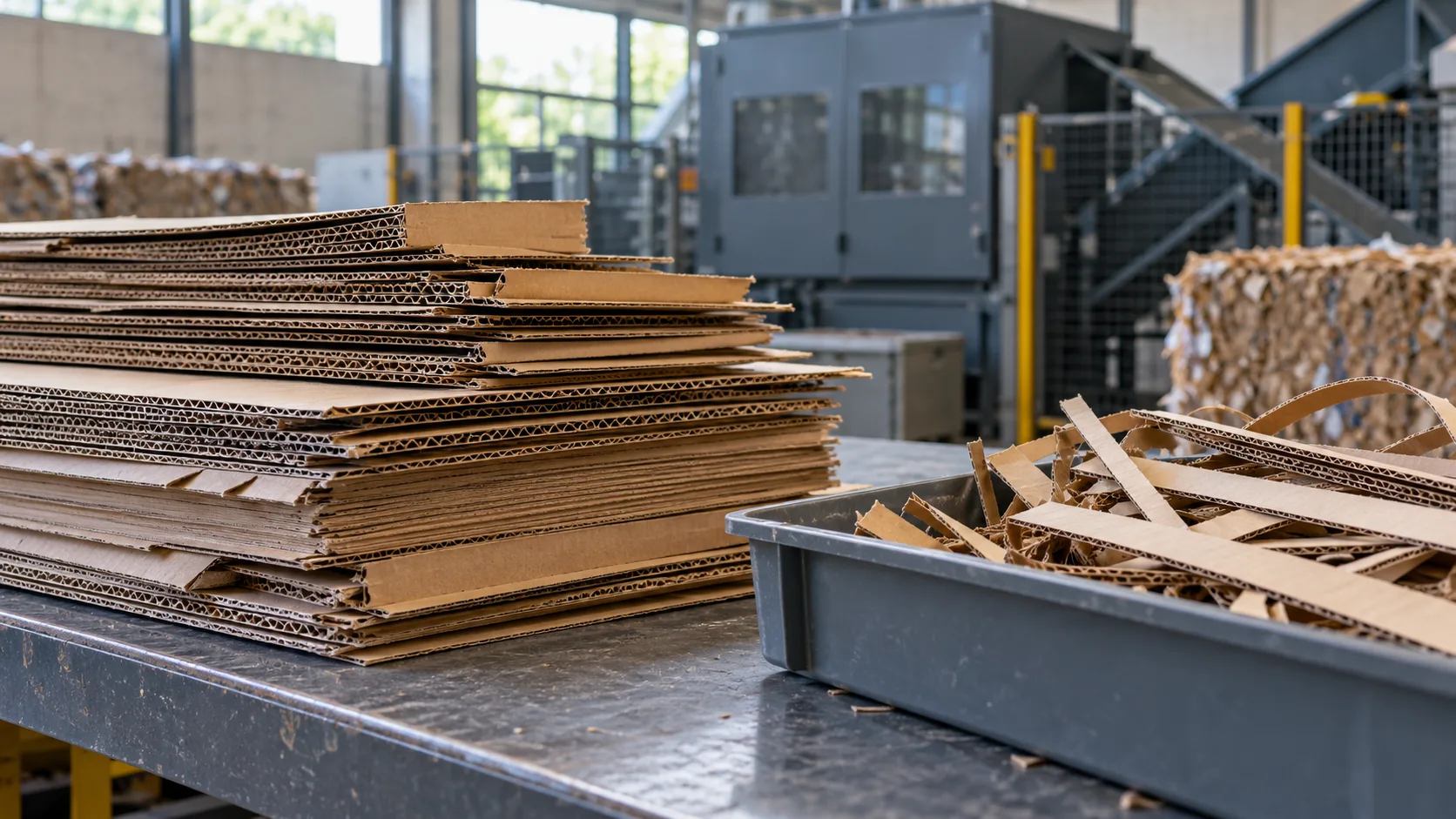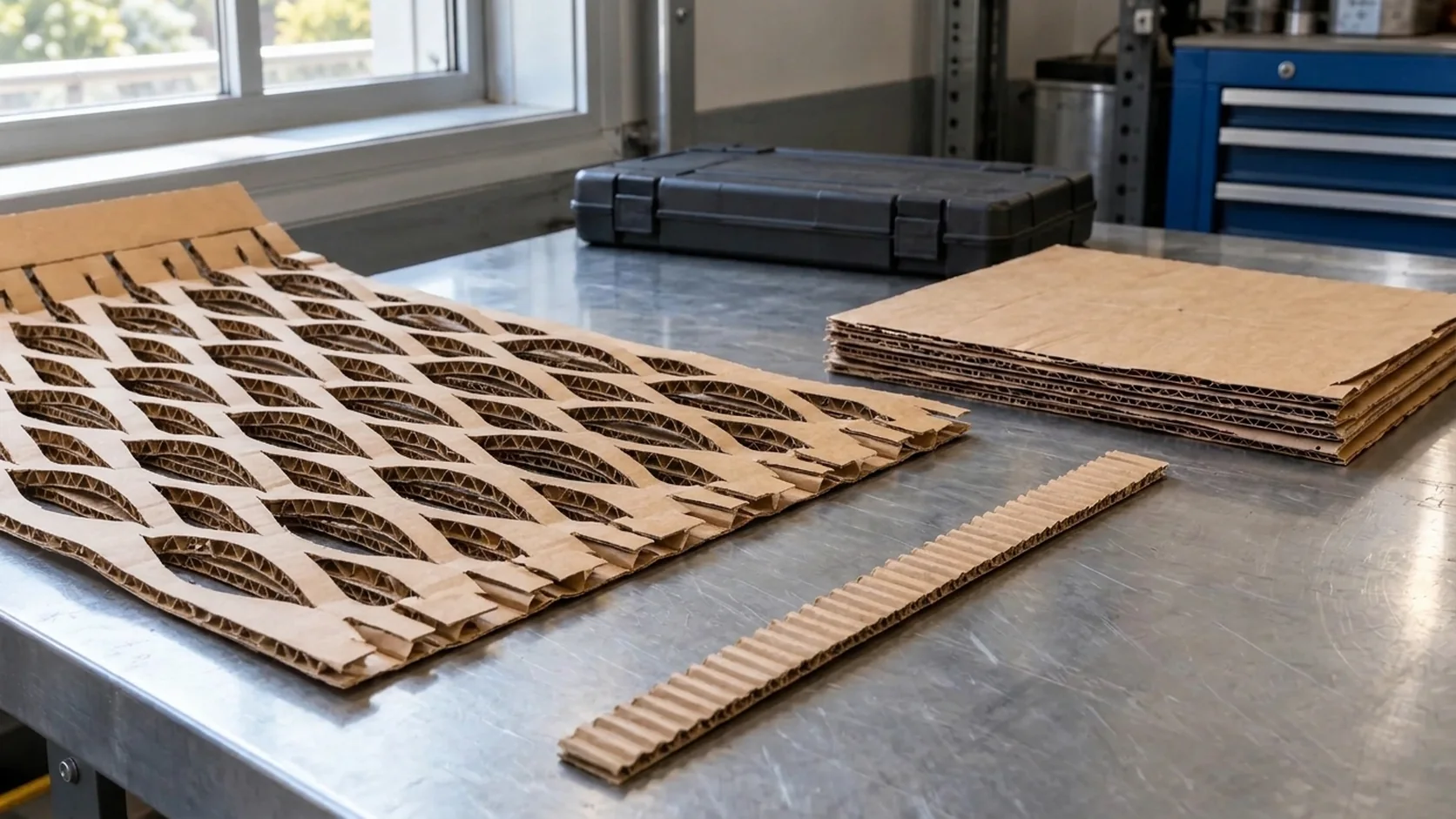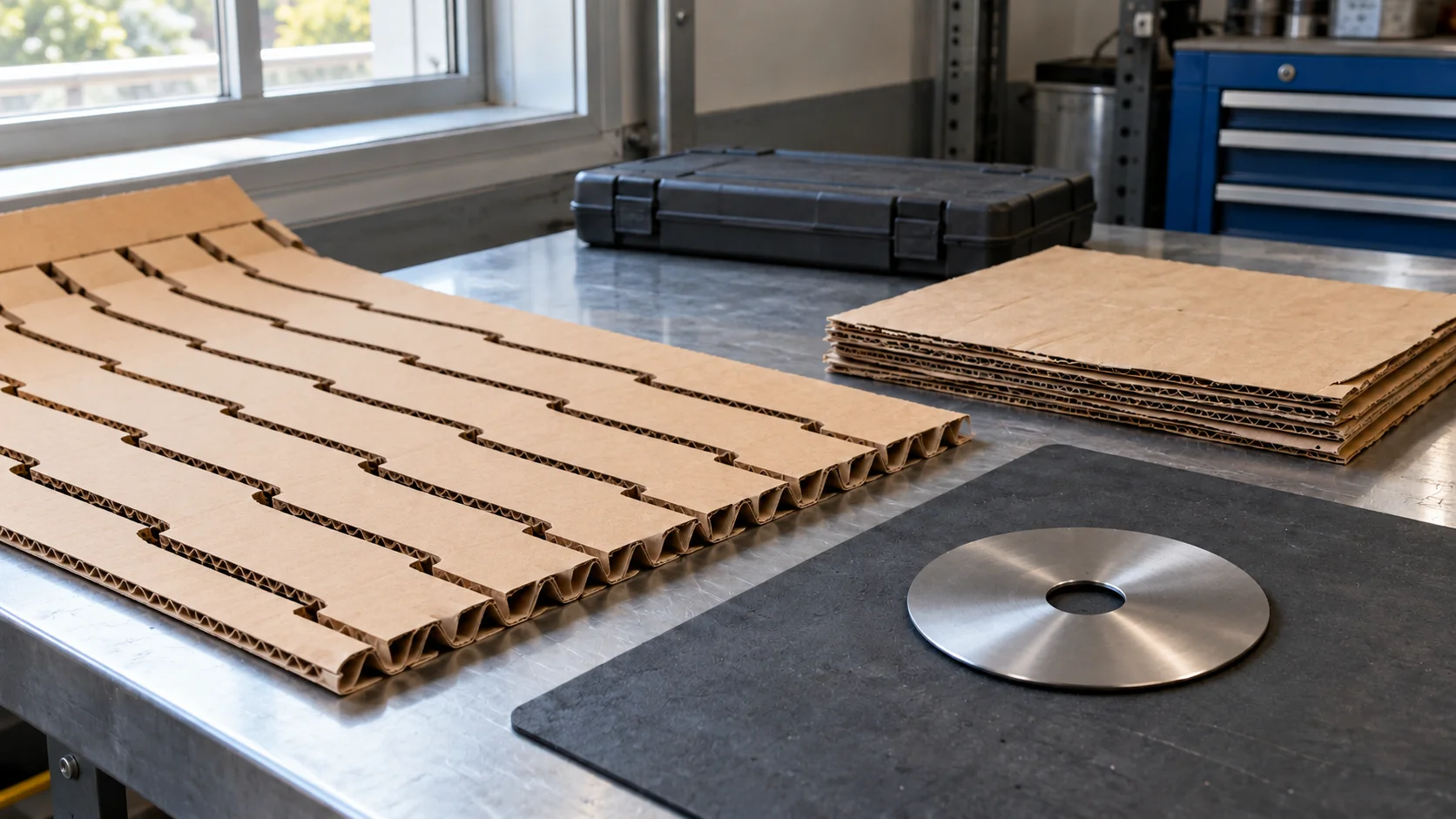
A cardboard shredder machine can lose useful throughput to jams and trim handling even when its blade types appear suited to the job. Select the documented cutter/output configuration first, check working width, total feed thickness and permitted sheet count independently, then compare useful material produced over the complete operating interval.
Choose a cardboard shredder machine by its documented cut result and feed envelope. A connected mat, a bolstered mat and loose chips create different handling tasks; a padding setting can change the output without establishing a different blade assembly. For throughput, preserve the exact model, electrical configuration and rating unit. Record the incoming board, preparation, feeding pauses and useful-output yield before using a published maximum to size a packing station.
Blade types and throughput. Match the output, check the feed, measure useful material.
- Cut result
- Feed limits
- Useful output
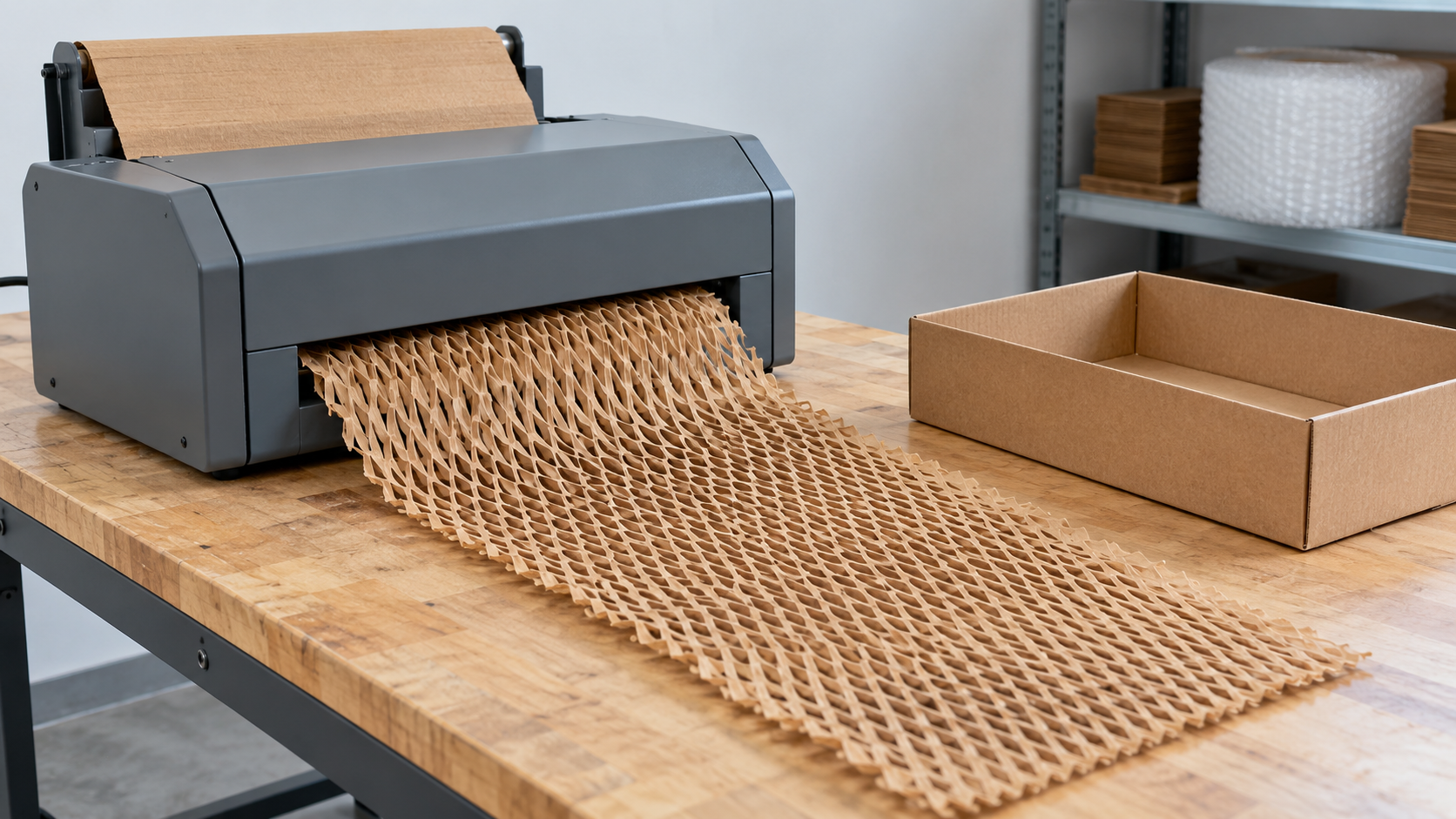
Bench converter arrangement feeding a connected corrugated mat into an adjacent collection tray.
The following quick specifications are published examples from HSM’s ProfiPack product overview, revision September 2026, page 6.
| Input or item | Typical value or source | Why it matters |
|---|---|---|
| Working width | HSM C400 product 1528134: 415 mm; P425 products 1531154 and 1533154: 425 mm; September 2026 overview, p. 6 | Determines processed width; excess board may create a separate trim-handling task. |
| Layer count and feed height | Same source: C400, 1 layer and max. 10 mm; listed P425 configurations, up to 3 layers and max. 20 mm | Both limits apply to the actual stack, including folds. |
| Electrical configuration and power label | Same source: P425 1531154, 220–240 V / 50/60 Hz and 2.0 kW power consumption | Preserve the configuration and label; meter actual energy over the conversion interval to calculate kWh per useful kilogram. |
| Required output | HSM overview, September 2026, pp. 3–4: connected flat/bolstered mats versus chips | Select collection, handling and packout before comparing capacities. |
| Useful throughput | Useful output mass divided by complete elapsed time | Includes the effect of pauses and rejects that a maximum rating cannot resolve. |
Distinguish cutter output from compression mode
The supported distinction is between documented cutting results and output settings. HSM’s September 2026 overview describes hardened cutting rollers, flat or bolstered mats from C400/P425 machines, and chips from ecoChip. Its P425 operating instructions, edition February 2020, English pages 13–14, separately describe perforating and padding arrangements. A compression setting therefore should not be counted as evidence of an interchangeable blade type.
Obtain replacement knife part numbers, shaft clearances, and service intervals from the specific machine’s parts and maintenance manual.
| Documented configuration or action | What the source establishes | Dominant Failure Mode & Prevention |
|---|---|---|
| Perforating rollers producing a connected mat | HSM September 2026 overview, pp. 3–4; February 2020 P425 manual, pp. 13–16 | Feed stack blocks the cutting nip. Apply both the layer and height limits, sort the feed and follow the exact model’s fault instructions. |
| P425 padding arrangement | February 2020 manual, p. 14: output compression arrangement changes | Residue obstructs a mode change. The manual requires residue removal when changing from padding to perforating; use its safe shutdown and cleaning sequence. |
| Chip-producing configuration | HSM September 2026 overview, pp. 3 and 7: ecoChip chip output varies with feed direction | Loose output fails the intended collection or packout task. Preserve a sample and verify containment and placement. |
| Automatic trimming of over-width board | February 2020 P425 manual, p. 13: excess width is cut off automatically | Trim sorting or another pass reduces useful yield. Record the strip’s mass and handling time; its eventual usefulness determines whether it is a reject. |
Cutter durability and finished-pad handling safety also have different boundaries. The OEM-authored PacMaster S manual, document 88034 11 06/15, English page 4, requires removal of metal clips and staples because they can injure people handling the pads. Apply the selected machine’s material restrictions and the finished pack’s requirements; a roller’s resistance to staples cannot approve metal in the cushioning.
Apply height and sheet-count limits together
A proposed stack must satisfy both physical gates. For the P425 configurations on page 6 of HSM’s September 2026 overview, reject the proposed feed if measured total thickness exceeds 20 mm OR the stack exceeds 3 cardboard sheets/layers. Meeting these ceilings is necessary; board construction and condition can still limit successful feeding. The layer count here does not mean corrugated flute count or triple-wall construction.
Threshold example: 3 sheets × 8 mm/sheet = 24 mm, exceeding the sourced P425 height ceiling of 20 mm despite meeting its sheet-count ceiling. Measure the actual stack, including creases and folds, rather than multiplying a nominal board thickness.
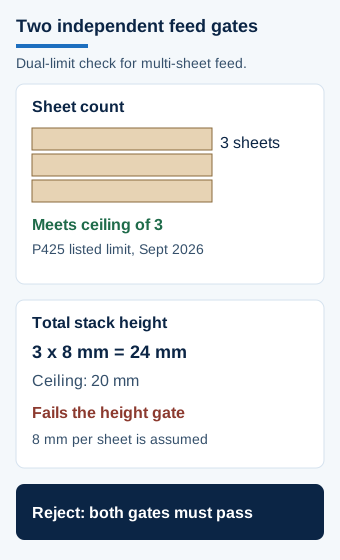
Dual-gate intake check: a three-sheet stack at 8 mm per sheet reaches 24 mm total height, exceeding the 20 mm P425 feed-height limit despite meeting the 3-layer limit.
Working width adds a separate handling decision. The February 2020 P425 manual, page 13, specifies a processed width of 425 mm and automatic cut-off of wider board. This does not require pre-cutting every wider blank, but the separated strip still needs a collection and disposition plan. Watch the whole route from incoming carton to accepted padding.
Compare the exact configuration and rating unit
Published capacities are meaningful only with their configuration and unit. The following values all come from HSM’s ProfiPack product overview, revision September 2026, page 6.
| Model and product number | Width; layers; maximum feed height | Supply | Power consumption, OEM label | Published throughput | Dominant Failure Mode & Prevention |
|---|---|---|---|---|---|
| C400, 1528134 | 415 mm; 1 layer; 10 mm | 230 V / 50 Hz | 0.7 kW | Up to 50 kg/h | Feed stack exceeds the 10 mm or 1-layer gate. Measure the actual stack before feeding. |
| P425 AC, 1531154 | 425 mm; up to 3 layers; 20 mm | 220–240 V / 50/60 Hz | 2.0 kW | Up to 80 kg/h | The 80 kg/h label is used without the 20 mm and 3-layer gates. Apply both feed limits and record useful yield. |
| P425 three-phase, 1533154 | 425 mm; up to 3 layers; 20 mm | 400 V / 50 Hz | 3.8 kW | Up to 120 kg/h | The historical motor-power wording is substituted for this configuration’s power-consumption label, or the 20 mm and 3-layer gates are skipped. Keep the September 2026 label with both feed gates. |
The overview recommends the C400 for occasional use and the listed P425 configurations for continuous operation. Continuous-duty suitability does not remove feed or overload limits. For operations converting 200+ folded double-wall cartons per shift, see our heavy duty cardboard shredder selection guide for double-wall boxes for 400V 3-phase cutter shaft torque math (T_req), IEC 60034-1 S1 thermal duty ratings, and helical-bevel gearbox cooling. The older February 2020 P425 manual, page 16, labels its 3.8 kW value motor power max. Preserve that historical wording rather than substituting it for another configuration’s power-consumption label.
Linear feed speed, mass flow and loose output volume measure different things. The intimus PacMaster S/VS data sheet, page 2, lists up to 7 m³/h for S and up to 11 m³/h for VS, explicitly dependent on feeding type and paper quality. Convert volumetric output to mass using measured bulk density under a defined compression state before comparing against kg/h ratings.
Calculate useful throughput from the material flow
Useful throughput depends on the material moving through the machine, the fraction of time feeding and the share retained as useful output. For steady rectangular feeding, dimensional mass balance gives:
Q_useful = 60 × v × w × σ × n × u × y
Here Q_useful is kg/h; v is actual feed speed in m/min; w is actual processed width in m; σ is the measured mass per area of a complete corrugated sheet in kg/m²; n is the simultaneous sheet count within the machine limits. u is feeding time divided by complete elapsed time, and y is useful-output mass divided by processed-input mass. Both are dimensionless fractions. The factor 60 min/h converts the time unit.
Worked example: Q_useful = 60 min/h × 8 m/min × 0.40 m × 0.60 kg/m² × 1 sheet × 0.50 feeding fraction × 0.90 useful fraction = 51.84 kg/h.
The utilization fraction absorbs sorting pauses, reversals and handling within the selected interval, while the yield fraction excludes rejected output. Record reprocessed trim consistently so that it is not counted as new useful material on every pass.
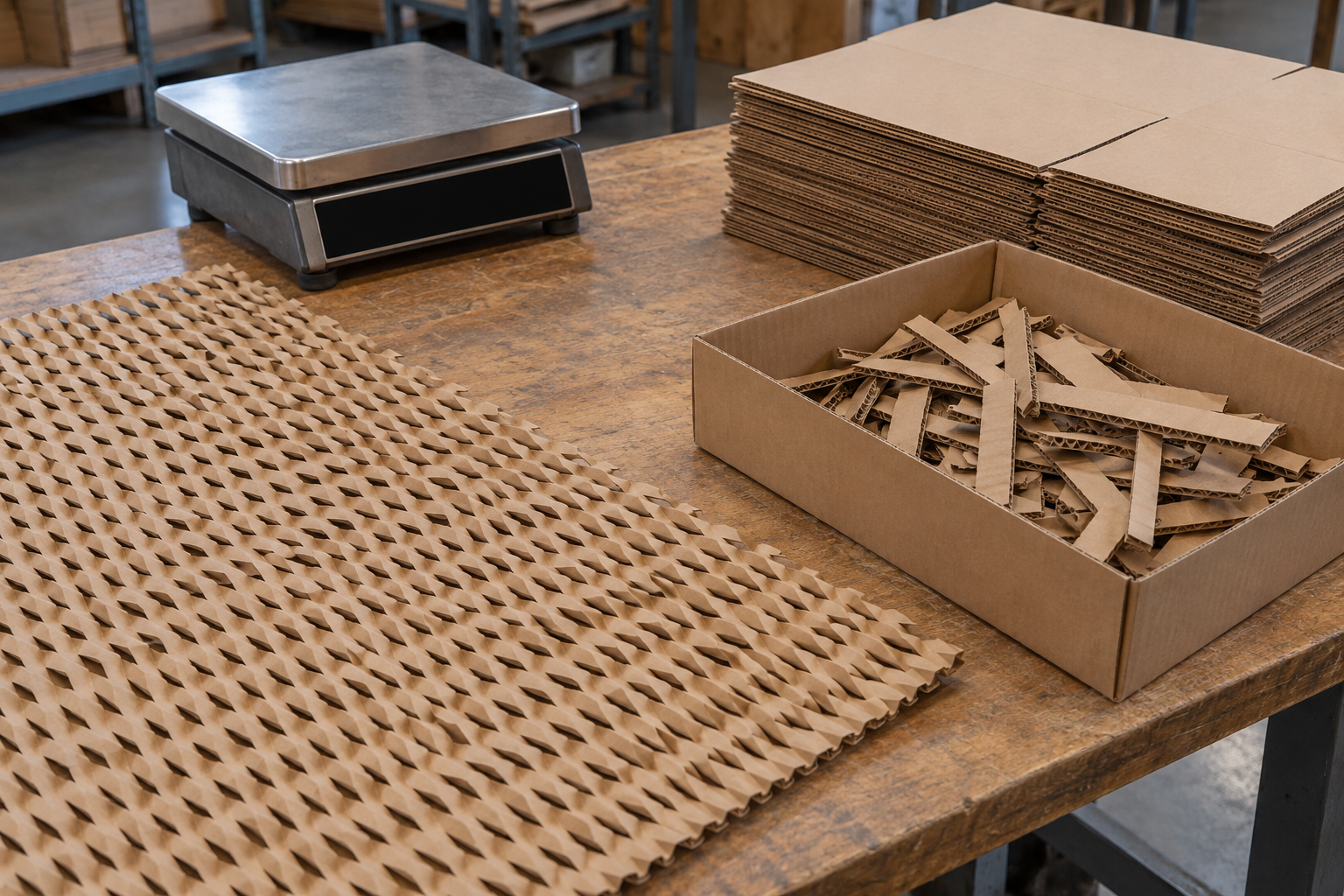
Workstation layout separating incoming flattened board, connected corrugated mat output, and side-trim collection.
For an actual station, weigh useful output and divide by the complete elapsed interval as a direct check. The formula then helps explain whether feed speed, preparation time or yield caused the difference. If the downstream void-fill workstation cannot consume the output at that rate, include collection and storage in the operating record.
Measure expansion separately from protective performance
A cut dimension cannot establish expanded volume or cushioning performance. The February 2020 P425 manual, page 16, lists a 5 × 100 mm grid dimension for that documented configuration.
To compare mat handling, record the same sample’s initial and expanded dimensions under a declared tension and report the measurement method. Keep planar area change separate from the envelope volume of a bolstered mat. Neither establishes shock absorption or permission to remove another protective component.
Use the cushioning packout guide to define the product, placement method, damage criteria and acceptance evidence. Feed compatibility, an attractive mesh and successful package protection answer separate questions.
Count preparation, rejects, stops and energy
The useful operating comparison includes the complete material-conversion interval. Record these fields alongside the machine configuration and incoming board condition:
| Record | Measurement boundary | Decision it supports |
|---|---|---|
| Preparation and trim | Attended sorting/cutting minutes; trim mass and disposition | Whether incoming board can supply the required useful output without excessive handling |
| Feeding and interruptions | Feed minutes, reversals, thermal stops and changeover/cleanout minutes | Whether availability or the cutting process limits output |
| Useful material and rejects | Mass in kg, including reprocessing disposition | A consistent useful-yield calculation |
| Energy | Metered kWh over the same complete interval; identify included auxiliaries | Energy intensity = measured kWh / useful kg |
| Attended labor | Paid preparation, conversion and transfer minutes without overlapping entries | Operator time intensity = attended minutes / useful kg |
A nameplate power value alone cannot provide energy intensity. Worked interval example: for a useful output of 40 kg, metered energy of 8.0 kWh including the declared extractor, and attended time of 90 minutes with no overlapping entries, Energy intensity = 8.0 kWh / 40 kg = 0.20 kWh/kg and Operator time intensity = 90 min / 40 kg = 2.25 min/kg. Include idle consumption and any extractor inside the declared system boundary; the dust-extraction interface guide helps identify that boundary. Use maintenance and jam records when repeated stops dominate the result, and carry actual material and labor changes into the reuse cost worksheet.
Technical basis and scope
This reference draws on HSM’s ProfiPack product overview (September 2026, pp. 3–4 and 6–7), HSM’s ProfiPack P425 operating instructions (February 2020, English pp. 13–16), and intimus PacMaster S/VS data sheets and operating manuals (document 88034 11 06/15). The cardboard-shredder collection connects these selection checks to installation and upkeep.